Showing posts with label characteristics. Show all posts

Deriving Lessons from Hadith (Hadith No. 822)


Salam,
Bismillah.
These are repeats: Ahadith 818819820 and 821.

Prophet (SAW) was a perfect man. His words and actions were full of wisdom. Surely we have a lot  to learn from him. Everyone can derive lessons from a simple Hadith according to his/her level of understanding. A child will learn something from a Hadith, an adult will learn two or three things from that same Hadith. Whereas doctors, engineers, psychologists, nutritionists, lawyers, fuqahaa', businessmen will all have a different approach to that one Hadith.


This is why while going through Bukhari, it's weird that some Ahadith (apparently) have no connection with the chapter they're written under. And that one Hadith is repeated around 20 times (more or less) in different chapters But it makes one realize how deep Imam Bukhari's understanding was, that he could derive so many lessons from one Hadith. MashaAllah. May Allah have mercy on him, and grant him Jannat-ul-Firdaws. And may He grant me a chance to meet him in Jannah as well. <3
So I'll study today's Hadith, and try to derive as many lessons as possible. You give it a shot as well!

Volume 1, Book 12, Number 822:
Narrated 'Abdur Rahman bin 'Abis:
A person asked Ibn Abbas, "Have you ever presented yourself at the ('Id) prayer with Allah's Apostle?" He replied, "Yes." And had it not been for my kinship (position) with the Prophet it would not have been possible for me to do so (for he was too young). The Prophet went to the mark near the house of Kathir bin As-Salt and delivered a sermon. He then went towards the women. He advised and reminded them and asked them to give alms. So the woman would bring her hand near her neck and take off her necklace and put it in the garment of Bilal. Then the Prophet and Bilal came to the house."
  • One learns a lot by asking questions. Develop the habit! BUT, avoid pointless questions.
  • Good company will lead to good influence, and eventually good deeds inshaAllah.
  • Take your family along while going for `Id prayer. Men, women, boys, girls are all encouraged to gather for `Id prayer.
  • Teaching women is important. Teaching them 'especially' is important as well (hint: sisters-only halaqahs). They're the mothers of the Ummah. They're awesome like that. :)
  • It is permissible to ask for donations - for a good cause.
I can't think of anything else right now. Can you?
Wassalam.

The Friday Ghusl (Hadith No. 817)


Salam,
Bismillah.

Volume 1, Book 12, Number 817:
Narrated Abu Said Al-Khudri:
The Prophet said, "Ghusl (taking a bath) on Friday is compulsory for every Muslim reaching the age of puberty."

Fuqahaa' (experts in Islamic jurisprudence) say it's mustahabb (recommended) to do ghusl on Fridays.
As for the question about women's doing ghusl on Fridays, read this.


Do read about some other virtues of Friday. :)
Wassalam.

How'd You Know? (Hadith No. 816)


Salam,
Bismillah.

Volume 1, Book 12, Number 816:
Narrated Sulaiman Ash-Shaibam:
I heard Ash-Sha'bi saying, "A person who was accompanying the Prophet passed by a grave that was separated from the other graves told me that the Prophet once led the people in the (funeral) prayer and the people had aligned behind him. I said, "O Aba 'Amr! Who told you about it?" He said, "Ibn Abbas."

Taking the last part of this Hadith.. I'd like to bring your attention to a certain matter: reporting. There's some manners to it.

A Muslim is (ideally) an honest and trustworthy person. Whatever comes out of his mouth should be nothing but the truth. And this automatically entails that whatever incident he reports and any person that he quotes, is 100% truth. It's his responsibility to make sure that he doesn't forward a report (via speech, email or text messaging etc.) without verifying it. Yes, it's a tough job. But it's worthwhile because:
Ibn 'Umar reported said that the Prophet, may Allah bless him and grant him peace, said, "The worst of lies is when a man says his eyes have seen something which they have not seen." [al-Bukhari]

And there's this Hadith I cannot seem to find English translation of. Help in this regard much appreciated.
انسان کے جھوٹا ہونے کے لئے اتنا ہی کافی ہے کہ جو بات سنے لوگوں سے پیان کرنا شروع کر دے۔
So when someone tells you about something, ask them: how'd you know?
P.S. sharing statuses, retweeting tweets comes in this category as well. Make SURE to do your research before you press that button!
Wassalam.

Garlic, Onion and the Mosque (Ahadith 812 - 815)


Salam,
Bismillah.

Volume 1, Book 12, Number 812:
Narrated Ibn 'Umar:
During the holy battle of Khaibar the Prophet said, "Whoever ate from this plant (i.e. garlic) should not enter our mosque."

Volume 1, Book 12, Number 813:
Narrated 'Ata':
I heard Jabir bin 'Abdullah saying, "The Prophet said, 'Whoever eats (from) this plant (he meant garlic) should keep away from our mosque." I said, "What does he mean by that?" He replied, "I think he means only raw garlic."


Volume 1, Book 12, Number 814:
Narrated Jabir bin 'Abdullah:
The Prophet said, "Whoever eats garlic or onion should keep away from our mosque or should remain in his house." (Jabir bin 'Abdullah, in another narration said, "Once a big pot containing cooked vegetables was brought. On finding unpleasant smell coming from it, the Prophet asked, 'What is in it?' He was told all the names of the vegetables that were in it. The Prophet ordered that it should be brought near to some of his companions who were with him. When the Prophet saw it he disliked to eat it and said, 'Eat. (I don't eat) for I converse with those whom you don't converse with (i.e. the angels)."


Seriously, that bad? :/
Volume 1, Book 12, Number 815:
Narrated 'Abdul 'Aziz:
A man asked Anas, "What did you hear from the Prophet about garlic?" He said, "The Prophet said, 'Whoever has eaten this plant should neither come near us nor pray with us."

Us Pakistanis enjoy onion and garlic in our food a lot. Well, most of us. Alhamdulillah. Nothing wrong with that. But one must be careful about one thing: don't pray at home/in the masjid when your mouth reeks of onion or garlic (or any other foul smell, for the matter).
Think about it, Salah is like whispering to your Loved One. Would you like to have bad breath at that time? :/


Solution: brush your teeth after eating such food. Clean your tongue well. Use mouth wash. Miswaak is the best. (y)
Wassalam. 

That Thing About Turning From One's Right Side.. (Hadith No. 811)


Salam,
Bismillah.

Volume 1, Book 12, Number 811:
Narrated 'Abdullah:
You should not give away a part of your prayer to Satan by thinking that it is necessary to depart (after finishing the prayer) from one's right side only; I have seen the Prophet often leave from the left side.

Bid`ah busted. (y)
Now you know it's not Sunnah to turn from one's right side only. Keep it cool. ;)


Wassalam. 

Leaving After Prayer.. Immediately (Hadith No. 810)


Salam,
Bismillah.
Hadith no. 809 is a repeat. Read it here.

Volume 1, Book 12, Number 810:
Narrated 'Uqba:
I offered the 'Asr prayer behind the Prophet at Medina. When he had finished the prayer with Taslim, he got up hurriedly and went out by crossing the rows of the people to one of the dwellings of his wives. The people got scared at his speed . The Prophet came back and found the people surprised at his haste and said to them, "I remembered a piece of gold lying in my house and I did not like it to divert my attention from Allah's worship, so I have ordered it to be distributed (in charity)."


So like it's good to remain sitting on your prayer place for a while after finishing your prayer. It gives you time to do the after-Salah adhkaar and make du`a. But, if it's an emergency, you may leave your place immediately. For something as important as Prophet (SAW) had to do in this particular Hadith.

And SubhanAllah, the kind of stuff that worried the Messenger of Allah (SAW). Like whoa!

Wassalam.

Imaam's Forgotten Sunnah (Ahadith 806-808)


Salam,
Bismillah.

There's something Prophet (SAW) used to do after finishing his prayer, which I don't see many Imaams doing today. And it makes me sad. :(

Volume 1, Book 12, Number 806:
Narrated Samura bin Jundab:
The Prophet used to face us on completion of the prayer.

Volume 1, Book 12, Number 807:
Narrated Zaid bin Khalid Al-Juhani:
The Prophet led us in the Fajr prayer at Hudaibiya after a rainy night. On completion of the prayer, he faced the people and said, "Do you know what your Lord has said (revealed)?" The people replied, "Allah and His Apostle know better." He said, "Allah has said, 'In this morning some of my slaves remained as true believers and some became non-believers; whoever said that the rain was due to the Blessings and the Mercy of Allah had belief in Me and he disbelieves in the stars, and whoever said that it rained because of a particular star had no belief in Me but believes in that star.'"


This particular image shows the imaam addressing the congregation while standing. Hadith does not say anything about standing, so Imaam may face the congregation in sitting position as well.
Volume 1, Book 12, Number 808:
Narrated Anas bin Malik:
Once the Prophet delayed the 'Isha' prayer until midnight and then came to us. Having prayed he faced us and said, "The people had prayed and slept but you were in the prayer as long as you were waiting for it."

Facing congregation after the prayer is a Sunnah for the Imaam. It's easier to address people that way as well.
Wassalam.

Dhikr after Salah - 1 (Hadith No. 804)


Salam,
Bismillah.

Volume 1, Book 12, Number 804:
Narrated Abu Huraira:
Some poor people came to the Prophet and said, "The wealthy people will get higher grades and will have permanent enjoyment and they pray like us and fast as we do. They have more money by which they perform the Hajj, and 'Umra; fight and struggle in Allah's Cause and give in charity." The Prophet said, "Shall I not tell you a thing upon which if you acted you would catch up with those who have surpassed you? Nobody would overtake you and you would be better than the people amongst whom you live except those who would do the same. Say "Sub-han-al-lah", "Alhamdu-lillah" and "Allahu Akbar" thirty three times each after every (compulsory) prayer." We differed and some of us said that we should say, "Subhan-al-lah" thirty three times and "Alhamdu lillah" thirty three times and "Allahu Akbar" thirty four times. I went to the Prophet who said, "Say, "Subhan-al-lah" and "Alhamdu lillah" and "Allahu Akbar" all together for thirty three times."


 Sunnah: say takbir 33 or 34 times, tahmeed 33 times, and tasbeeh 33 times after every compulsory Salah.
It's something you can do in about a minute, and gain reward equal to those who perform Hajj and Umrah, fight in Allah's Cause, and give in charity. Won't you do it then? :)

Wassalam.

The Takbir After Salah (Ahadith 800, 802-803)


Salam,
Bismillah.

Volume 1, Book 12, Number 800:
Narrated 'Itban bin Malik:
We prayed with the Prophet and used to finish our prayer with the Taslim along with him.

Hadith no. 801 is a repeat. Read it here.

Volume 1, Book 12, Number 802:
Narrated Abu Ma'bad (the freed slave of Ibn 'Abbas):
Ibn 'Abbas told me, "In the lifetime of the Prophet it was the custom to celebrate Allah's praises aloud after the compulsory congregational prayers." Ibn 'Abbas further said, "When I heard the Dhikr, I would learn that the compulsory congregational prayer had ended."


Volume 1, Book 12, Number 803:
Narrated Ibn 'Abbas:
I used to recognize the completion of the prayer of the Prophet by hearing Takbir.

Sunnah: say 'Allahu Akbar' loudly after finishing your compulsory (fardh) Salah.

There's lots of other adhkaar we find in Sunnah that Prophet (SAW) used to do after finishing his fardh Salah. Some of them will be posted in the following days inshaAllah.

Wassalam. 

Separating Pathways (Hadith No. 799)


Salam,
Bismillah.
Hadith no. 798 is a repeat. Read it here
Volume 1, Book 12, Number 799:
Narrated Um Salama:
Whenever Allah's Apostle finished his prayers with Taslim, the women would get up and he would stay on for a while in his place before getting up. Ibn Shihab said, "I think (and Allah knows better), that the purpose of his stay was that the women might leave before the men who had finished their prayer."
The idea is to not have women and men passing through the same pathway. Either separate pathways completely, or have them pass through separately.

I wish I had the time to remove the watermark. :|
Just do it. (y)
Wassalam.

The Way to Tashahhud (Hadith No. 797)


Salam,
Bismillah.

Volume 1, Book 12, Number 797:
Narrated 'Abdullah:
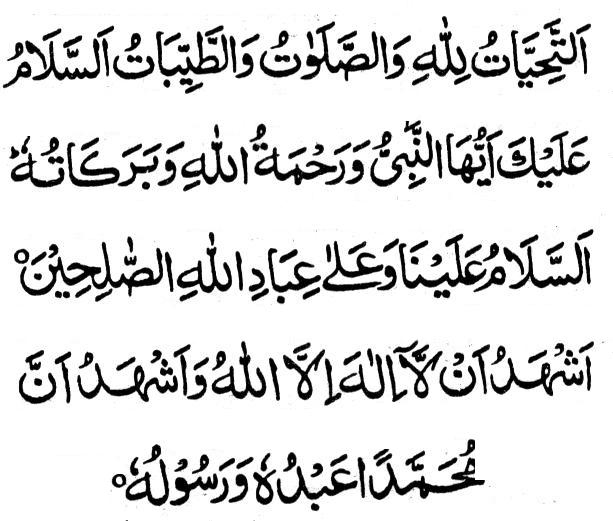
When we prayed with the Prophet we used to say, "Peace be on Allah from His slaves and peace be on so and so." The Prophet said, "Don't say As-Salam be on Allah, for He Himself is As-Salam, but say, 'At-tahiyatu lil-lahi was-salawatu wat-taiyibatu. As-salamu 'Alaika aiyuhan-Nabiyu warahmatu-l-lahi wa barakatuhu. As-salamu 'alaina wa 'ala ibadillahis-salihin. (If you say this then it will be for all the slaves in heaven or between heaven and earth). Ashhadu an la-ilaha illallahu wa ashhadu anna Muhammadan 'Abduhu wa Rasuluhu.' Then select the invocation you like best and recite it." 


(See Hadith No. 794795 & 796).

P.S. you don't have to select one du`a. You can recite as many as you want.  When you sit for Tashahhud, recite the first du`a, which is mandatory: at-tahiyyatu lillahi...

After that comes the Durud: Allahumma salli `alaa muhammadin...

And after that, select the invocation you like best and recite it. There are a lot of options to choose from. Bring variety to your Salah. :)

Wassalam.

Tashahhud Du`a - 3 (Hadith No. 796)


Salam,
Bismillah.

Volume 1, Book 12, Number 796:
Narrated Abu Bakr As-Siddiq:
I asked Allah's Apostle to teach me an invocation so that I may invoke Allah with it in my prayer. He told me to say, "Allahumma inni zalumtu nafsi zulman kathiran, Wala yaghfirudhdhunuba illa anta faghfirli maghfiratan min 'Indika, war-hamni innaka antal-ghafururrahim (O Allah! I have done great injustice to myself and none except You forgives sins, so please forgive me and be Merciful to me as You are the Forgiver, the Merciful)."

A relevant page here.

اللهم اني ظلمت نفسي ظلما كثيرا ولا يغفر الذنوب الا انت فاغفرلي مغفرة من عندك وارحمني انك انت الغفور الرحيم

Wassalam.

Tashahhud Du`a - 2 (Hadith No. 795)


Salam,
Bismillah.

Volume 1, Book 12, Number 795:
Narrated 'Aisha (the wife of the Prophet):
Allah's Apostle used to invoke Allah in the prayer saying "Allahumma inni a'udhu bika min adhabil-qabri, wa a'udhu bika min fitnatil-masihid-dajjal, wa a'udhu bika min fitnatil-mahya wa fitnatil-mamati. Allahumma inni a'udhu bika minal-ma thami wal-maghrami. (O Allah, I seek refuge with You from the punishment of the grave and from the afflictions of Masi,h Ad-Dajjal and from the afflictions of life and death. O Allah, I seek refuge with You from the sins and from being in debt)."
Somebody said to him, "Why do you so frequently seek refuge with Allah from being in debt?" The Prophet replied, "A person in debt tells lies whenever he speaks, and breaks promises whenever he makes (them)."
'Aisha also narrated: I heard Allah's Apostle in his prayer seeking refuge with Allah from the afflictions of Ad-dajjal.

In Arabic:

 اللهم إني أعوذ بك من عذاب القبر، و أعوذ بك من فتنة المسيح الدجال، و أعوذ بك من فتنة المحيا وفتنة الممات،  اللهم إني أعوذ بك من المأثم والمغرم

Another version of the same du`a:

This is not one of the mandatory du`as of tashahhud. But since Prophet (SAW) used to recite it a lot, one must try and follow this particular Sunnah as much as possible.
Wassalam.

Tashahhud Du`a - 1 (Hadith No. 794)


Salam,
Bismillah.
There's a list of du`as that can be recited in tashahhud. For your ease, I'm doing one du`a a post.

Volume 1, Book 12, Number 794:
Narrated Shaqlq bin Salama:
'Abdullah said, "Whenever we prayed behind the Prophet we used to recite (in sitting) 'Peace be on Gabriel, Michael, peace be on so and so. Once Allah's Apostle looked back at us and said, 'Allah Himself is As-Salam (Peace), and if anyone of you prays then he should say, At-Tahiyatu lil-lahi wassalawatu wat-taiyibatu. AsSalamu 'alalika aiyuha-n-Nabiyu wa rahmatu-l-lahi wa barakatuhu. As-Salam alaina wa ala ibadil-lah is-salihin. (All the compliments, prayers and good things are due to Allah: peace be on you, O Prophet and Allah's mercy and blessings be on you. Peace be on us an on the true pious slaves of Allah). (If you say that, it will be for all the slaves in the heaven and the earth). Ash-hadu an la-ilaha illa-l-lahu wa ash-hadu anna Muhammadan 'abduhu wa Rasuluhu. (I testify that none has the right to be worshipped but Allah and I also testify that Muhammad is His slave and His Apostle)."


I'm sure you all know this one by heart, and you should! It's mandatory to recite it in tashahhud.

Do keep its translation and meaning in mind while reciting it though. It's really beautiful. AND it has a very interesting story behind it. Who knows it? :)

Wassalam.

On Missing the First Tashahhud (Ahadith 791-793)


Salam,
Bismillah.

Volume 1, Book 12, Number 791:
Narrated Muhammad bin 'Amr bin 'Ata':
I was sitting with some of the companions of Allah's Apostle and we were discussing about the way of praying of the Prophet. Abu Humaid As-Saidi said, "I remember the prayer of Allah's Apostle better than any one of you. I saw him raising both his hands up to the level of the shoulders on saying the Takbir; and on bowing he placed his hands on both knees and bent his back straight, then he stood up straight from bowing till all the vertebrate took their normal positions. In prostrations, he placed both his hands on the ground with the forearms away from the ground and away from his body, and his toes were facing the Qibla. On sitting In the second Rak'a he sat on his left foot and propped up the right one; and in the last Rak'a he pushed his left foot forward and kept the other foot propped up and sat over the buttocks."

 Volume 1, Book 12, Number 792:
Narrated 'Abdullah bin Buhaina:
(he was from the tribe of Uzd Shan'u'a and was the ally of the tribe of 'Abdul-Manaf and was one of the companions of the Prophet): Once the Prophet led us in the Zuhr prayer and stood up after the second Rak'a and did not sit down. The people stood up with him. When the prayer was about to end and the people were waiting for him to say the Taslim, he said Takbir while sitting and prostrated twice before saying the Taslim and then he said the Taslim."

Volume 1, Book 12, Number 793:
Narrated 'Abdullah bin Malik bin Buhaina:
Once Allah's Apostle led us in the Zuhr prayer and got up (after the prostrations of the second Rak'a) although he should have sat (for the Tashah-hud). So at the end of the prayer, he prostrated twice while sitting (prostrations of Sahw).
  • Sitting after two rak'aat is important. If one forgets to do so, he must perform sajda sahw: two sujud (prostrations) at the end of the prayer.
  • If one forgets to perform sajda sahw before Taslim (saying Salam), he may do the two prostrations after Taslim.
Wassalam.

'Fast Salah' (Ahadith 782-784)


Salam,
Bismillah.

The importance of slowing down in your Salah has been repeated multiple times in Bukhari up till now. And here it comes again:

Volume 1, Book 12, Number 782:
Narrated Abu Qilaba:
Once Malik bin Huwairith said to his friends, "Shall I show you how Allah's Apostle used to offer his prayers?" And it was not the time for any of the compulsory congregational prayers. So he stood up (for the prayer) bowed and said the Takbir, then he raised his head and remained standing for a while and then prostrated and raised his head for a while (sat up for a while). He prayed like our Sheikh 'Amr Ibn Salama. (Aiyub said, "The latter used to do a thing which I did not see the people doing i.e. he used to sit between the third and the fourth Rak'a). IMalik bin Huwairith said, "We came to the Prophet (after embracing Islam) and stayed with him. He said to us, 'When you go back to your families, pray such and such a prayer at such and such a time, pray such and such a prayer at such and such a time, and when there is the time for the prayer then only of you should pronounce the Adhan for the prayer and the oldest of you should lead the prayer."


Volume 1, Book 12, Number 783:
Narrated Al-Bara':
The time taken by the Prophet in prostrations, bowing, and the sitting interval between the two prostrations was about the same.

Volume 1, Book 12, Number 784:
Narrated Thabit:
Anas said, "I will leave no stone unturned in making you offer the prayer as I have seen the Prophet making us offer it." Anas used to do a thing which I have not seen you doing. He used to stand after the bowing for such a long time that one would think that he had forgotten (the prostrations) and he used to sit in-between the prostrations so long that one would think that he had forgotten the second prostration.

Discussion on it here.

Brothers and sisters, whatever you do, do NOT pray a 'fast Salah' like this person:

[youtube=http://www.youtube.com/watch?v=jc1FiK_K80Q]

SunhanAllah! Someone give him the khushoo` pill!
Wassalam.

Disqus Shortname

designcart