Showing posts with label fajr. Show all posts

Fasting & Intention (Hadith No. 1642)

Bismillah.
Is it necessary to make an intention before fasting? If yes, when to make that intention?
Volume 3, Book 31, Number 147:
Narrated Salama bin Al-Akwa (radiallaahu `anhu):
Once the Prophet (sallallaahu `alayhi wasallam) ordered a person on 'Ashura' (the tenth of Muharram) to announce, "Whoever has eaten, should not eat any more, but fast, and who has not eaten should not eat, but complete his fast (till the end of the day).

The Ruling

It was narrated by Ibn ‘Umar from Hafsah (may Allaah be pleased with her) that the Prophet (peace and blessings of Allaah be upon him) said:
Whoever does not have the intention of fasting before Fajr, there is no fast for him.
Narrated by Imam Ahmad, the authors of al-Sunan, Ibn Khuzaymah and Ibn Hibbaan; they classed it as saheeh and marfoo’.

Obligatory or Voluntary?

Summary: For obligatory fasts, intention has to be made before Fajr that day. But for voluntary fasts, intention can be made later on during the day if one hasn't eaten/drunk/had intercourse after Fajr that day. Read below for details.
It is essential to make the intention to fast the month of Ramadan at night, before Fajr. It is not sufficient to start fasting it that day without the intention. Whoever finds out at the time of Duha that today it is Ramadan and makes the intention of fasting has to refrain from eating until sunset, and he also has to make up that day. This is with regard to obligatory fasts. With regard to naafil (voluntary) fasts it is permissible to make the intention to fast on the day, if you have not eaten or drunk or had intercourse after Fajr, because it was proven in the hadeeth of ‘Aa’ishah (may Allaah be pleased with her) that the Prophet (peace and blessings of Allaah be upon him) entered upon her one day at duha time and said, “Do you have anything (any food)?” She said, “No.” He said, “Then I am fasting.” Narrated by Muslim in his Saheeh

Suhoor and Adhaan (Ahadith 1637 - 1639)

Bismillah.
When should you take your suhoor meal? Till dawn or the adhaan?
Volume 3, Book 31, Number 142:
Narrated 'Aisha (radiallaahu `anhaa):
Bilal (radiallaahu `anhu) used to pronounce the Adhan at night, so Allah's Apostle (sallallaahu `alayhi wasallam)? said, "Carry on taking your meals (eat and drink) till Ibn Um Maktum [Bilal] pronounces the Adhan, for he does not pronounce it till it is dawn.

Volume 3, Book 31, Number 143:
Narrated Sahl bin Sad (radiallaahu `anhu):
I used to take my Suhur meals with my family and then hurry up for presenting myself for the (Fajr) prayer with Allah's Apostle (sallallaahu `alayhi wasallam).

Volume 3, Book 31, Number 144:
Narrated Anas (radiallaahu `anhu):
Zaid bin Thabit (radiallaahu `anhu) said, "We took the Suhur with the Prophet (sallallaahu `alayhi wasallam). Then he stood for the prayer." I asked, "What was the interval between the Suhur and the Adhan?" He replied, "The interval was sufficient to recite fifty verses of the Quran."
The ruling is that you "eat and drink until the white thread (light) of dawn appears to you distinct from the black thread (darkness of night)." [al-Baqarah 2:187]
Translation: eat and drink till dawn starts. Whether the adhaan starts before it or after is irrelevant; you just have to look for the dawn.
Also, it's better to delay the suhoor meal till dawn. Imam Ahmad recorded Abu Dharr saying that Allah's Messenger said:
«لَا تَزَالُ أُمَّتِي بِخَيْرٍ مَا عَجَّلُوا الْإِفْطَارَ وَأَخَّرُوا السُّحُور»My Ummah will always retain goodness as long as they hasten in breaking the fast and delay the Suhur.


Taken from:  http://ilookilisten.wordpress.com/2013/07/24/suhoor-and-adhaan-ahadith-1637-1639/

Morning Routine (Ahadith 955 - 961)


Assalamu`alaykum,
Bismillah.

What do you know about the morning routine of the Prophet (SAW)?

Volume 2, Book 21, Number 256:
Narrated 'Aisha;
Allah's Apostle offered the 'Isha' prayer (and then got up at the Tahajjud time) and offered eight Rakat and then offered two Rakat while sitting. He then offered two Rakat in between the Adhan and Iqama (of the Fajr prayer) and he never missed them.

Volume 2, Book 21, Number 257:
Narrated 'Aisha:
The Prophet used to lie down on his right side, after offering two Rakat (Sunna) of the Fajr prayer.

Volume 2, Book 21, Number 258:
Narrated 'Aisha:
After offering the Sunna of the Fajr prayer, the Prophet used to talk to me, if I happen to be awake; otherwise he would lie down till the Iqama call was proclaimed (for the Fajr prayer).

Volume 2, Book 21, Number 259:
Narrated 'Aisha:
After offering the two Rakat (Sunna) the Prophet (p.b.u.h) used to talk to me, if I happen to be awake; otherwise he would lie down.


Volume 2, Book 21, Number 260:
Narrated 'Aisha:
The Prophet was never more regular and particular in offering any Nawafil than the two Rakat (Sunna) of the Fajr prayer.

Volume 2, Book 21, Number 261:
Narrated 'Aisha:
Allah's Apostle used to offer thirteen Rakat in the night prayer and on hearing the Adhan for the morning prayer, he used to offer two light Rakat.

Volume 2, Book 21, Number 262:
Narrated 'Aisha:
The Prophet (p.b.u.h) used to make the two Rakat before the Fajr prayer so light that I would wonder whether he recited Al-Fatiha (or not).
  1. He would never miss the two rak`aat (Sunnah) before Fajr prayer.
  2. He would make them very light. (Surah al-Kafiroon in first rak`ah and Surah al-Ikhlaas in the second).
  3. He would chit chat with his wife (Aisha) if she was awake, otherwise he'd lie down to wait for iqamah.
This is up till the Fajr prayer. Who knows what he (SAW) used to do after that? #acceptchallengeandanswer ;)

Wassalam.

Between Suhoor and Fajr (Hadith No. 934)


Assalamu`alaykum,
Bismillah.

Volume 2, Book 21, Number 235:
Narrated Qatada:
Anas bin Malik said, "The Prophet (p.b.u.h) and Zaid bin Thabit took their Suhur together. When they finished it, the Prophet stood for the (Fajr) prayer and offered it." We asked Anas, "What was the interval between their finishing the Suhur and the starting of the morning prayer?" Anas replied, "It was equal to the time taken by a person in reciting fifty verses of the Quran."

So about 8-10 minutes, they waited for Fajr. Maybe they finished their suhoor early and it wasn't time for Fajr yet. Or maybe they were preparing for Salah (doing wudu), or making du`a, or just having a conversation. Could be anything.

Point is, they waited for Fajr after suhoor.
Wassalam. 

Recitation in Fajr Prayer (Hadith No. 873)


Assalamu`alaykum,
Bismillah.

Volume 2, Book 19, Number 174:
Narrated Abu Huraira:
On Fridays the Prophet used to recite Alif Lam Mim Tanzil: As-Sajdah (32) (in the first Raka) and Hal ata 'alal-lnsani i.e. Surat ad-Dahr (76) (in the second Raka), in the Fajr prayer.

This is about the fardh prayer of Fajr. Prophet (SAW) used to recite specific Surahs in the Fajr Sunnah prayer as well. Who remembers them? :) [Find answer here.]
Imaam Bukhari brought this hadith under the chapter of Sajdah of Tilawat because Surah as-Sajdah has one of those ayaat which when Prophet (SAW) recited them, made sajdah (prostration) of tilawat (recitation of Qur'an).

إِنَّمَا يُؤْمِنُ بِآيَاتِنَا الَّذِينَ إِذَا ذُكِّرُوا بِهَا خَرُّوا سُجَّدًا وَسَبَّحُوا بِحَمْدِ رَبِّهِمْ وَهُمْ لَا يَسْتَكْبِرُونَ ۩

"Only those believe in Our Ayat (proofs, evidence, verses, lessons, signs, revelations, etc.), who, when they are reminded of them, fall down prostrate, and glorify the Praises of their Lord, and they are not proud." [As-Sajdah: 15]


Wassalam.

Qunoot (Ahadith 813 - 816)


Assalamu`alaykum,
Bismillah.

This is the last post from Kitaab-ul-Witr. Alhamdulillah, it was covered in detail. We start Kitaab-ul-Istisqaa' [Book of Invoking Allah fro Rain] tomorrow inshaAllah.

Volume 2, Book 16, Number 813:
Narrated Muhammad bin Sirin:
Anas was asked, "Did the Prophet recite Qunut in the Fajr prayer?" Anas replied in the affirmative. He was further asked, "Did he recite Qunut before bowing?" Anas replied, "He recited Qunut after bowing for some time (for one month)."

Volume 2, Book 16, Number 814:
Narrated 'Asim:
I asked Anas bin Malik about the Qunut. Anas replied, "Definitely it was (recited)". I asked, "Before bowing or after it?" Anas replied, "Before bowing." I added, "So and so has told me that you had informed him that it had been after bowing." Anas said, "He told an untruth (i.e. "was mistaken," according to the Hijazi dialect). Allah's Apostle recited Qunut after bowing for a period of one month." Anas added, "The Prophet sent about seventy men (who knew the Quran by heart) towards the pagans (of Najd) who were less than they in number and there was a peace treaty between them and Allah's Apostles (but the Pagans broke the treaty and killed the seventy men). So Allah's Apostle recited Qunut for a period of one month asking Allah to punish them."

Volume 2, Book 16, Number 815:
Narrated Anas bin Malik:
The Prophet recited Qunut for one month (in the Fajr prayer) asking Allah to punish the tribes of Ral and Dhakwan.

Volume 2, Book 16, Number 816:
Narrated Anas:
The Qunut used to be recited in the Maghrib and the Fajr prayers.

Qunoot, according to the definition of the fuqaha’, “is the name of a du’aa’ (supplication) offered during prayer at a specific point while standing.” It is prescribed in Witr prayer after the rukoo’ (bowing), according to the more correct of the two scholarly opinions. 
If a calamity (naazilah) befalls the Muslims, it is prescribed to say Du’aa’ al- Qunoot after standing up from rukoo’ in the last rak’ah of each of the five daily obligatory prayers, until Allaah relieves the Muslims of that calamity.

Before or After Rukoo`?

Shaykh al-Islam [Ibn Taymiyah] said in Majmoo’ al-Fataawa (23/100): 
With regard to qunoot: there are two extreme views and one middle (or moderate) view. Some say that qunoot should only be recited before bowing and some say that it should only be recited after bowing. The fuqaha’ among the scholars of hadeeth, such as Ahmad and others, say that both are allowed, because both are mentioned in the saheeh Sunnah, but they preferred reciting qunoot after bowing because this is mentioned more often. 
[IslamQA]

Raising Hands

Raising the hands is mentioned in a saheeh report from  ‘Umar (may Allaah be pleased with him), as was narrated by al-Bayhaqi in a report which he classed as saheeh (2/210). 
The worshipper should raise his hands to chest height and no more, because this du’aa’ is not a du’aa’ of supplication in which a person needs to raise his hands high. Rather it is a du’aa’ of hope in which a person holds out his palms towards heaven… The apparent meaning of the scholar’s words is that the worshipper should hold his hands close together like a beggar who asks someone else to give him something. 

Qunoot in Witr

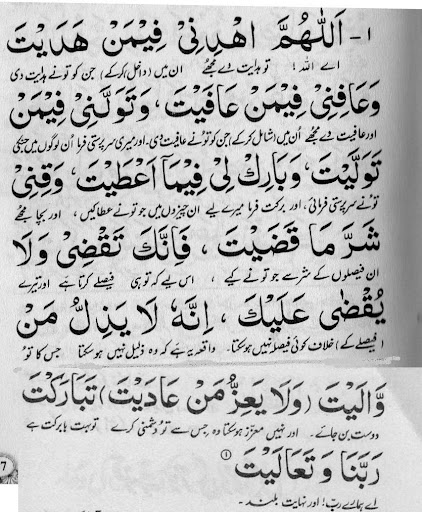
The version which the Messenger of Allaah (peace and blessings of Allaah be upon him) taught to al-Hasan ibn ‘Ali (may Allaah be pleased with him), which is: 
“Allaahumma ihdini feeman hadayta wa ‘aafini feeman ‘aafayta wa tawallani feeman tawallayta wa baarik li feema a’tayta, wa qini sharra ma qadayta , fa innaka taqdi wa la yuqda ‘alayk, wa innahu laa yadhillu man waalayta wa laa ya’izzu man ‘aadayta, tabaarakta Rabbana wa ta’aalayta la munji minka illa ilayk."
(O Allaah, guide me among those whom You have guided, pardon me among those whom You have pardoned, turn to me in friendship among those on whom You have turned in friendship, and bless me in what You have bestowed, and save me from the evil of what You have decreed. For verily You decree and none can influence You; and he is not humiliated whom You have befriended, nor is he honoured who is Your enemy. Blessed are You, O Lord, and Exalted. There is no place of safety from You except with You).”
(Narrated by Abu Dawood, 1213; al-Nasaa’i, 1725; classed as saheeh by al-Albaani in al-Irwa’, 429). 
It was narrated from ‘Ali ibn Abi Taalib that the Prophet (peace and blessings of Allaah be upon him) used to say at the end of Witr
“Allaahumma inni a’oodhu bi ridaaka min sakhatika wa bi mu’aafaatika min ‘uqoobatika wa a’oodhu bika minka, la uhsi thana’an ‘alayka anta kama athnayta ‘ala nafsika (O Allaah, I seek refuge in Your pleasure from Your wrath and in Your forgiveness from Your punishment. I cannot praise You enough; You are as You have praised Yourself.” 
(Narrated by al-Tirmidhi, 1727; classed as saheeh by al-Albaani in al-Irwa’, 430; Saheeh Abi Dawood, 1282). 
Then he should send blessings upon the Prophet (peace and blessings of Allaah be upon him) as it was narrated that some of the Sahaabah (may Allaah be pleased with them) – including Ubayy ibn Ka’b and Mu’aadh al-Ansaary (may Allaah be pleased with them) – did that at the end of Qunoot al-Witr. 
(See Tasheeh al-Du’aa’ by Shaykh Bakr Abu Zayd, p. 460).

Qunoot in Witr Every Night?

There is nothing wrong with that. The du’aa’ of Qunoot is Sunnah and the Prophet (blessings and peace of Allah be upon him) used to recite Qunoot. He taught Qunoot and the words of Qunoot in Witr to al-Hasan, so it is Sunnah. If you recite it every night, there is nothing wrong with that, and if you omit it on some occasions so that the people will know that it is not obligatory, there is nothing wrong with that either. If the imam omits Qunoot on some occasions so that the people will know that is not obligatory, there is nothing wrong with that. When the Prophet (blessings and peace of Allah be upon him) taught al-Hasan Qunoot, he did not tell him to omit it on some days. This indicates that if he does it persistently, there is nothing wrong with that.
Shaykh ‘Abd al-‘Azeez ibn Baaz (may Allah have mercy on him).
[IslamQA]

Qunoot at times of calamity (Qunoot al-Naazilah) 

When praying Qunoot at the time of calamity, one should make supplication as is appropriate to the situation, as it was narrated that the Prophet (peace and blessings of Allaah be upon him) cursed some Arab tribes who had betrayed his companions and killed them, and he prayed for the weak and oppressed believers in Makkah, that Allaah would save them.  It was narrated that ‘Umar prayed Qunoot with the following words:
“Allaahumma inna nasta’eenuka wa nu’minu bika, wa natawakkalu ‘alayka wa nuthni ‘alayka al-khayr, wa laa nakfuruka. Allaahumma iyyaaka na’budu wa laka nusalli wa nasjudu, wa ilayka nas’aa wa nahfid. Narju rahmataka wa nakhsha ‘adhaabaka, inna ‘adhaabaka al-jadd bil kuffaari mulhaq. Allaahumma ‘adhdhib il-kafarata ahl al-kitaab alladheena yasuddoona ‘an sabeelika."
(O Allaah, verily we seek Your help, we believe in You, we put our trust in You and we praise You and we are not ungrateful to You. O Allaah, You alone we worship and to You we pray and prostrate, for Your sake we strive. We hope for Your mercy and fear Your punishment, for Your punishment will certainly reach the disbelievers.  O Allaah, punish the infidels of the People of the Book who are preventing others from following Your way).” 
This version is a bit different than the one in text above. But it works.
(Narrated by al-Bayhaqi, 2/210; classed as saheeh by al-Albaani in al-Irwa’, 2/170. Al-Albaani said: This was reported from ‘Umar concerning Qunoot in Fajr, and it seems that this Qunoot is Qunoot al-Naazilah (Qunoot at times of calamity) as is indicated by his praying against the kuffaar).

Saying Ameen after Qunoot

It is prescribed to say Ameen during the du’aa’ al-qunoot.
It is not obligatory to say the Ameen out loud, rather it is mustahabb, just as the Ameen itself is not obligatory.
[IslamQA]

Making Qunoot Calamity-Appropriate

Shaykh Ibn ‘Uthaymeen said in al-Sharh al-Mumti’ (4/45): He should say Qunoot with a supplication that is appropriate to the calamity that has come. Hence the Messenger (blessings and peace of Allaah be upon him) used to say Qunoot with words that were appropriate to the calamity, and he did not say “Allaahumma ihdini fiman hadayta/O Allaah, guide me among those whom You have guided…” as some of the common folk do. It is not narrated in any hadeeth, saheeh or da’eef, that the Messenger (blessings and peace of Allaah be upon him) ever used to say “Allaahumma ihdini fiman hadayta/O Allaah, guide me among those whom You have guided…”) in obligatory prayers; rather he would offer a supplication that was appropriate to that calamity. On one occasion, he (blessings and peace of Allaah be upon him) prayed for some of the weak and oppressed people, asking Allaah to save them, until they came (to him in Madeenah). End quote.
Based on this, the worshipper should choose a supplication that is appropriate to the calamity, and say that.
Whoever says the du’aa’ of the Prophet (blessings and peace of Allaah be upon him) because it is appropriate to a calamity that has befallen the Muslim, such as saying with regard to that which has befallen us nowadays, “O Allaah, save the weak and oppressed believers in Gaza; O Allaah, help them; O Allaah, punish the Jews and Christians, and those who support and help them, severely; O Allaah, curse them; O Allaah, send upon them years like the years of Yoosuf,” has done well, because the supplication of the Prophet (blessings and peace of Allaah be upon him) is the best and most comprehensive supplication that can be offered.
And Allaah knows best.
[IslamQA]
A very detailed post on Qunoot here, and the answer to "for how long should the qunoot nazila be recited" here.
Ahhhh! I don't know about you, but I definitely learnt a LOT of new stuff today. Alhamdulillah. <3
Wassalam.

Quick Fajr Sunnahs (Hadith No. 807)


Assalamu`alaykum,
Bismillah.

Volume 2, Book 16, Number 807:
Narrated Anas bin Sirin:
I asked Ibn 'Umar, "What is your opinion about the two Rakat before the Fajr (compulsory) prayer, as to prolonging the recitation in them?" He said, "The Prophet (p.b.u.h) used to pray at night two Rakat followed by two and so on, and end the prayer by one Raka Witr. He used to offer two Rakat before the Fajr prayer immediately after the Adhan." (Hammad, the sub-narrator said, "That meant (that he prayed) quickly.)"

Similar Hadith here.
  1. Prophet (SAW) used to pray two rak`aat (Sunnah) before Fajr prayer right after the Adhaan.
  2. He prayed them quickly or lightly, meaning he did not prolong recitation in them.
  3. We get to know from other narrations that he used to recite Surah al-Kafiroon in the first rak`ah and Surah al-Ikhlaas in the second rak`ah of the Fajr Sunnah prayers.
Abu Hurairah (May Allah be pleased with him) reported: The Messenger of Allah (PBUH) recited in the two supererogatory Rak`ah of the Fajr prayer Surat Al-Kafirun (No. 109) [in the first Rak`ah], and Surat Al-Ikhlas (No. 112) [in the second rak`ah].
[Muslim]
Gets interesting:
He [SAWS] heard a man reciting the former soorah in the first rak’ah (Surah Kafiroon), so he said, “This is a slave who believes in his Lord.” Then the man recited the latter soorah in the second rak’ah (Surah Ikhlas), so he said, “This is a slave who knows his Lord.”
[Al-Albani in "The Prophet's Prayer Described"]
And here's a nice relative blog post I came across. :)
Wassalam.

The Fajr of Friday Prayer (Hadith No. 714)


Assalamu`alaykum,
Bismillah.

Volume 2, Book 13, Number 714:
Narrated Abu Huraira:
The Prophet used to recite the following in the Fajr prayer of Friday, "Alif Lam Mim, Tanzil" (Surat-as-Sajda #32) and "Hal-ata-`ala-l-Insani" (i.e. Surah-Ad-Dahr #76).

If you didn't know this, chances are people around you don't know either. Spread the word. Yes, Imaams of masajid (mosques) too!
Wassalam.

The Hard Prayers (Hadith No. 626)


Salam,
Bismillah.

Which prayers do you find the HARDEST? Fajr? When you have to give up your comfy bed for Allah's sake.. Or 'Isha? When all you're thinking about is your cozy warm bed..
Sigh. It's a tough choice!

Volume 1, Book 11, Number 626:
Narrated Abu Huraira:
The Prophet said, "No prayer is harder for the hypocrites than the Fajr and the 'Isha prayers, and if they knew the reward for these prayers at their respective times, they would certainly present themselves (in the mosques) even if they had to crawl." The Prophet added, "Certainly I decided to order the Mu'adhin (call-maker) to pronounce Iqama and order a man to lead the prayer and then take a fire flame to burn all those who had not left their houses so far for the prayer along with their houses."

This Hadith talks about one of the qualities/characteristics of hypocrites. If you're thinking: 'oh, then it's not about me', you really need to continue reading. :)

If you find it hard to pray the Fajr and 'Isha prayers, you have this trait in you. Does that mean you're an absolute hypocrite? Not necessarily. BUT you have at least one trait of hypocrisy inside you. And you need to work on yourself to remove this trait. And pray hard!

When I find it hard to pray Fajr or 'Isha, I remember this Hadith. And to prove to myself that I'm not a hypocrite, I make extra effort for these specific prayers. It's just one of the ways I fight against my nafs. :P

Remember, the harder it is for you to pray, the more reward you'll get for praying it.

A similar Hadith discussed here.
Wassalam.

Taken from: http://ilookilisten.wordpress.com/2011/11/11/the-hard-prayers-hadith-no-626/

Sleeping and missing salaat al-fajr


A brother complained: “I miss salaat al-Ffjr on most days, and I hardly ever pray it at the right time. Usually I do not wake up until after the sun has risen, or at best I wake up after the time for praying fajr in jamaa’ah. I have tried to wake up at the right time, with no success. What is the solution to this problem?”


All praise be to Allaah.

The solution to this problem, like others, has two aspects: theoretical and practical.

The theoretical aspect may be further broken down into two points:

(1) The Muslim should know the great status of salaat al-fajr in the sight of Allaah, may He be glorified. The Prophet (peace and blessings of Allaah be upon him) said: “Whoever prays the dawn prayer in congregation, it is as if he had prayed the whole night long.” (Muslim, p. 454, no. 656; al-Tirmidhi, 221).

The Prophet (peace and blessings of Allaah be upon him) also said:

“The most burdensome prayers for the hypocrites are salaat al-’isha’ and salaat al-fajr, but if they only knew what they contain, they would come even if they had to crawl.” (Reported by Imaam Ahmad, al-Musnad, 2/424; Saheeh al-Jaami’, 133).

“Whoever prays fajr is under the protection of Allaah. Do not put yourselves in a situation where Allaah has to call you to account for your negligence.” (Reported by al-Tabaraani, 7/267; Saheeh al-Jaami’, no. 6344).

“Angels come to you in shifts by night and by day. They meet at salaat al-fajr and salaat al-‘asr, then those who had stayed with you at night ascend, and are asked by the One Who knows better than they: ‘How did you find My servants?’ They say, ‘We left them when they were praying, and we came to them when they were praying.’” (Reported by al-Bukhaari, al-Fath, 2/33).

“The best of prayers in the sight of Allaah is the dawn prayer on Friday, in congregation.” (Reported by Abu Na’eem in al-Hilyah, 7/207, and in al-Silsilah al-Saheehah, 1566).

According to a saheeh hadeeth: “Whoever prays al-Bardayn will enter Paradise.” (Reported by al-Bukhaari, al-Fath, 2/52). Al-Bardayn are fajr and ‘asr.

(2) The Muslim should understand the seriousness of missing salaat al-fajr. This is explained by the hadeeth already quoted:

“The most burdensome prayers for the hypocrites are salaat al-’isha’ and salaat al-Fajr…”

In al-Saheeh, it is reported that Ibn ‘Umar (may Allaah be pleased with them both) said: “If we did not see a person at fajr and ‘isha’ prayers, we would think badly of him.” (Reported by al-Tabaraani in al-Mu’jam al-Kabeer, 12/271. Al-Haythami said, the men of al-Tabaraani are muwaththaqoon (trustworthy). al-Majma’, 2/40). They thought badly of a person who was absent from these two prayers because regular performance of them is an indication of a person’s faith and a measure of his sincerity. Other prayers may be easier to do because they are more convenient to a person’s circumstances and fit in with his work and his sleep, but only those who are determined and sincere, people whom one hopes are good people, will be able to pray fajr and ‘isha’ regularly in congregation.

Another hadeeth which indicates the seriousness of missing salaat al-fajr is: “Whoever prays fajr is under the protection of Allaah. Do not put yourselves in a situation where Allaah has to call you to account for your negligence, because whoever finds himself in this situation will be sorted out and then thrown on his face in the Fire of Hell.” (Reported by Muslim, p. 454).

These two points are sufficient to guarantee that the Muslim’s heart will burn with the concern to ensure that he does not miss fajr. The first motivates him to strive to earn the reward for fajr, and the second acts as a warning that will deter him from committing the sin of negligence.

The practical aspect of dealing with this problem includes a number of steps which the Muslim can take in order to get used to performing salaat al-fajr regularly in congregation. These steps include:

Sleeping early. According to a saheeh hadeeth, the Prophet (peace and blessings of Allaah be upon him) used to dislike sleeping before ‘isha’ and talking afterwards. The Muslim should not sleep before salaat al-’isha’ because it is obvious that most of those who sleep before it will spend the rest of the night feeling so tired and heavy that it will be as if they are ill.

Also, the Muslim should not talk after ‘isha’, and the scholars have explained the reason why doing so is disliked: it is because doing so leads to people staying up late, which in turns leads to the fear that they will sleep and miss qiyaam al-layl, or the correct or preferred time for fajr prayer.

The kind of talk that is disliked after ‘isha’, as the commentators explain, is that in which there is no clear benefit, but if there is some benefit – such as studying and gaining knowledge, learning stories of righteous people, speaking to a guest, spending time with one’s wife and family, speaking to travellers and taking care of them and their luggage, or any other permissible reason – then there is nothing wrong with it. This has no connection with the reasons for which many people stay up late nowadays, to do wrong and commit sin! So the Muslim should sleep early, so that he can wake up refreshed to pray fajr and avoid the kind of late nights that make him too tired to get up and pray fajr in congregation.

It is a fact that people differ with regard to their need for sleep, so it is not possible to dictate a set number of hours that people should sleep, but each person should stick to the time that will give him enough sleep to wake up refreshed for salaat al-fajr. If a person knows from experience that sleeping after 11 p.m., for example, will mean that he cannot get up for fajr, then from an Islamic point of view he should not sleep any later than that… and so on.

Making sure that one is clean (taahir) and reciting adhkaar (prayers) before sleeping. This helps a person to get up for fajr.

Having a sincere intention and being determined, when going to sleep, that one will get up for fajr. But a person who goes to sleep hoping that the alarm will not go off, and that no one will come and wake him up, will not – with such a corrupt intention – be able to get up to pray fajr whilst he still has this bad intention.

Remembering Allaah as soon as one wakes up. Some people may initially wake up, then they go back to sleep again. But if a person remembers Allaah straight after waking up, this will loosen one of the knots of Shaytaan, and will motivate him to get up. When he performs wudoo’, his determination becomes stronger, and Shaytaan is driven further away, and when he prays, his shaytaan is defeated, his balance (of good deeds) becomes heavier, and he will feel happy and energetic.

Seeking help from one’s family and friends to pray fajr, and encouraging one another in this regard. This is essential, and is undoubtedly included in the words of Allaah (interpretation of the meanings):

“… Help you one another in al-birr and al-taqwa (virtue, righteousness and piety)…” [al-Maa’idah 5:2]

“By al-‘asr (time). Verily! Man is in loss, except those who believe and do righteous good deeds, and recommend one another to the truth and recommend one another to patience.” [al-‘Asr 103:1-3]

The Muslim should encourage his wife, for example by waking her up to pray fajr, and she should encourage him, no matter how tired and exhausted he may be. Children should also seek their father’s help to wake up, so he can wake them when it is time for the prayer. No father should say “They have exams, they are tired, let them sleep, poor kids.” It is a mistake to think that be doing this one is being a kind and merciful parent; true parental mercy means that the father wakes them up to worship Allaah. “And enjoin al-salaah (the prayer) on your family, and be patient in offering them (the prayers)…” [Ta-Ha 20:132 – interpretation of the meaning].

Just as family members should help and encourage one another to pray fajr, so brothers in Islam can also help one another. For example, university students living in the same residence or neighbours in the same neighbourhood can help one another by knocking on a neighbour’s door to wake him for prayer and helping him to worship Allaah.

Praying to Allaah to help him to wake up to pray fajr in congregation. Du’aa’ is one of the greatest sources of strength and success in all things.

Using various means of being woken up, such as alarm clocks. These should be put in the most appropriate place. Some people put the alarm clock next to their head, and when it rings, they turn if off at once and go straight back to sleep. Such a person should put the clock a little further away, so that he can feel that it is really waking him up.

One can also arrange to receive alarm calls from the telephone company, and no Muslim should think that it is too much to pay for this service if he needs it, because this is spending in the way of Allaah, and waking up to obey the command of Allaah cannot be measured in terms of worldly wealth.

Throwing water in the face of the person who is sleeping. The Prophet (peace and blessings of Allaah be upon him) praised the man who gets up at night to pray, and wakes his wife, and when she refuses to get up, he throws water in her face; and he praised the woman who gets up at night to pray, and wakes her husband, and when he refuses to get up, she throws water in his face. (Reported by Imaam Ahmad in al-Musnad, 2/250; Saheeh al-Jaami’, 3494).

Throwing water in a person’s face is one of the means of waking a person for prayer that is prescribed by sharee’ah. In fact it is quite refreshing and energizing. Some people may become enraged when woken in this manner, and they may shout and swear and issue threats, so the person who is seeking to wake another should employ wisdom and patience, and remember that the pens are lifted from the record of one who is sleeping (i.e., his deeds are not being recorded while he is asleep) – so he should put up with any bad treatment, and not let this put him off trying to wake people up for prayer.

Not sleeping alone. The Prophet (peace and blessings of Allaah be upon him) forbade any man to sleep alone. (Reported by Imaam Ahmad in al-Musnad, 2/91; al-Silsilah al-Saheehah, no. 60). Perhaps the wisdom behind this prohibition is that a person could sleep too long if there is no-one to wake him up for prayer.

Not sleeping in remote places where it would not occur to anyone that someone could be sleeping there, such as a person sleeping on the roof of a house without telling his family where he is, or sleeping in a remote part of the house or student residence, so that no-one will know to wake him for prayer, but everyone will think that he is in the mosque when in fact he is fast asleep. Anyone who needs to sleep in a remote place should tell the people around him where he will be so that they can come and wake him.

Being lively and active upon waking. One should get up straightaway, and not wake up in stages, as some people do. A person could be woken up several times, and each time he gets up, but when his friend leaves, he goes back to bed. Waking up in stages usually ends in failure, and the only way to prevent falling asleep again is to get up straight away.

Not setting the alarm too early. If a person knows that there is still a long time to go until the time of the prayer, he may think, “I still have time, let me sleep a little more…” Everyone should know how to handle himself and avoid this situation.

Lighting a lamp when waking up – or, in our modern times, switching on the light. This has the effect of dispelling sleepiness.

Not staying up late, even to pray qiyaam al-layl. Some people may stay up late to pray qiyaam al-layl, then fall asleep a few minutes before fajr and be unable to wake up for the prayer. This happens a lot in Ramadaan – people stay up late and sleep a little while before fajr, so they miss the prayer. No doubt this is a grave error, because fard (obligatory) prayer should take precedence over naafil (supererogatory) prayer. So what about those who stay up late not to pray but to commit sin, or at best to do permissible things? The Shaytaan may make the idea of staying up late to discuss important matters attractive to some daa’iyahs (Islamic workers), then they sleep late and miss the prayer, thus losing much more than they gained.

Not eating too much before going to sleep. Eating too much makes one sleep deeply. The one who eats a lot gets very tired, and sleeps a lot, thus losing a lot. So one should try to eat lightly in the evening.

Warning about the misinterpretation of the sunnah to lie down after praying the sunnah of fajr. Some people may have heard the hadeeth in which the Prophet (peace and blessings of Allaah be upon him) said: “When any one of you has prayed, let him lie down on his right side.” (Reported by al-Tirmidhi, no. 420; Saheeh al-Jaami’, 642). It was also reported that when the Prophet (peace and blessings of Allaah be upon him) had prayed the sunnah of fajr, he would lie down, then Bilaal would call him to prayer, and he would stand up to pray. People may have heard these ahaadeeth, and be keen to follow this proven sunnah, but they do not understand how to do it properly. So a person may pray the sunnah of fajr, then lie down on his right side, and fall fast asleep until the sun rises. This is because of a lack of proper understanding. The lying down is not for the purpose of sleeping, and Bilaal used to come and tell the Prophet (peace and blessings of Allaah be upon him) when it was time to pray. Moreover, as was reported by Imaam Ahmad and Ibn Hibbaan in a saheeh hadeeth, if the Prophet (peace and blessings of Allaah be upon him) wanted to rest before fajr, he would put his head on his right palm, propped up on his elbow. (Reported by Ahmad in al-Musnad, 5/298; Saheeh al-Jaami’, no. 4752). This kind of resting prevents one from falling fast asleep, because in this case one’s head is propped up on one’s palm and elbow, and will drop if one dozes off, thus waking one up again. In addition to this, Bilaal was entrusted with the responsibility of waking the Prophet (peace and blessings of Allaah be upon him) for the fajr prayer.

Praying qiyaam al-layl late in the night, just before fajr, so that when one finishes witr, the call for fajr prayer is given, making the worship continuous. The night prayer should be offered during the last third of the night – which is the preferred time – and immediately followed by the fajr prayer, whilst one is feeling awake and energetic.

Following the example of the Prophet (peace and blessings of Allaah be upon him) in lying down to sleep. So a person should lie on his right side, placing his right cheek on his right hand. This position makes it easy to wake up. The best guidance is the guidance of Muhammad (peace and blessings of Allaah be upon him), and this is better than sleeping in any other position which may make it difficult to wake up.

Helping oneself by taking a nap during the day, because this will help a person by making him need less sleep at night.

Not sleeping after ‘asr or maghrib, because this will make a person sleep late, and whoever sleeps late will find it difficult to wake up.

Finally, sincere devotion to Allaah is the best thing to motivate a person to get up for prayer, because Allaah is the One Who is controlling all means of help. If a person has that true sincerity and his heart is burning with devotion to Allaah, then Allaah will help him to get up to pray fajr in congregation, even if he goes to sleep only a few moments before fajr.

This sincerity and devotion may cause some very enthusiastic people to find unusual ways to help themselves to wake up to pray, which is a sign of their eagerness and keenness. One of them may set a number of alarm clocks to wake him up, setting each one a few minutes later than the other, so that if he turns the first one off, the next one will wake him a few moments later, and so on. Another may tie a string to his wrist, with the other end dangling from his window, so that when one of his friends passes by on his way to the mosque, he can pull on the string and wake him for fajr prayer.

See what can be achieved with sincerity and determination, may Allaah guide you! But the bitter truth is that weakness of faith and lack of sincerity are widespread among people nowadays, as we can see from the small numbers of people to be found praying in the mosques at fajr, despite the fact that there are so many people living around the mosques in many neighbourhoods.

But no doubt there are people who sleep so heavily that it is almost like an illness, and they may be excused, because the matter is beyond their control. People in this situation should turn to Allaah for help, and do everything that they possibly can, and visit the doctor, to try to find a cure.

Finally, a word about a well known phenomenon: some people claim that there is a hadeeth which says that the person who wants to get up for fajr should recite the last part of Soorat al-Kahf before sleeping, and have the intention in his heart to get up at a certain hour, and this will make him get up at that time. They claim that this is a tried and tested method. Our response is that there is no such saheeh hadeeth, and this carries no weight whatsoever. The best guidance is the guidance of Muhammad (peace and blessings of Allaah be upon him).

Why are we not able to wake up for Fajr ?


ONE

Make sure you to go to bed early, as the Prophet used to discourage sleep before performing Ishaa prayer and especially engaging in conversation after it, except in certain cases, some of which are enumerated by Imaam Nawawi in his explanation of Muslim's account.

Imaam An-Nawawi says:

“The reason why conversation after it is discouraged is the fear lest it leads to staying awake for long , which might induce drowsiness and difficulty with observing night prayers or Subh [dawn] prayer in their permitted, preferred or best times. The topics covered by this restriction are all fulfilling no good useful purpose. However, as to useful verbal activities, such as the pursuit of knowledge, listening to the wise tales of righteous people, talking to one's guest or bride, or members of one's family for the sake of company, interacting with travelers with a view to protect themselves and their goods, embarking on talks designed to conciliate between people or intercede before them in a good cause or to enjoin good and forbid evil and admonish people by pointing to a beneficial course of action to follow etc. there are no such restrictions.”

TWO

To bear in mind the great reward for attending Fajr prayer in congregation on time, and the strong rebuke for him to fails to observe it and to satisfy its conditions.

Uthmaan ibn 'Affaan (radiallaahu-anhu) related:

I heard Allah's Messenger say: "He who prays Ishaa in Jamaa'ah [congregation] is as if he has prayed for half the night. As to him who (also) prays Fajr in congregation, it is as if he has prayed all night.”[Reported by Muslim]

Ibn Mas'ud (radiallaahu-anhu) related: 

The case of a man who slept all the night up to sunrise (without waking up for Fajr) was related to the Prophet whereupon he said: "That was a man in whose ear Shaytaan has urinated", or he said "in both his ears". [Reported by Al-Bukhari and Muslim and An-Nasa’i]

The urinating is literally true, as Imaam Qurtubi says, since Shaytaan urinates and has sexual intercourse and procreates in a manner that Allah alone knows . To ascertain for yourself the truth of his assertion, look at the faces of those who come to deal in their daily business without having prayed Fajr in congregation at due time; look at their faces at working hours. You will surely ask Allaah for refuge from a lot as miserable as theirs. But, after all what do you expect from a person in whose heart Shaytaan has urinated!!!

THREE


To be assiduous in observing the Aadaab [good manners prescribed in Islam] as to what to do before sleep such as making Du'aa [supplication], bringing one's palms together, very mildly spitting into them and reciting the last three soorah's of the Qur'aan into them and them wiping them over one's face, head and body, being physically and religiously pure and performing a two rakah voluntary prayer after wudhoo [ablution]. A muslim has to ask his wife, parents, relatives or neighbours to help waking him up. Once waken up, he should not linger lazily for long in bed, lest he acquires the vices of the hypocrites who come to prayer showing ample signs of lazinessand lack of enthusiasm.


FOURTo fill one's heart with faith and good deeds. Once faith is alive in the heart, it induces the person to do good deeds and strive unremittingly hard. Faith is like a tree which only yields good fruit when irrigated from the streamlets of good deeds, thus bringing about an improvement both in personal conduct and at the interactional level with society at large. The lack of such streamlets or water supplies proportionately causes faith to wither and wilt. The heart is highly sensitive to external hardening stimuli, such as excess food or drink or aberrations in watching or listening (letting your eyes and ears loose to what is unlawful for them). You should therefore protect your heart from such external allurements.

FIVE

To keep away from Ma'aasi [acts of disobedience to Allah] by protecting the eyes, the tongue, the hearing and all the senses from indulging in the perception of objects that Allah has made unlawful for us. As an alternative, one should concern himself with matters pertaining to the worship of Allaah, such as devoting one's sight to the reading of Allaah's Book, meditating over the creatures that Allaah has created in this universe, reading books of knowledge etc.

One member of the rightly guided early generations was asked about the reason why people found it difficult to uphold voluntary prayers at night. He answered: "Your sins have shackled you". No doubt sins can be a major cause for a persons inability to enjoy the blessings of piety. As Imaam Ibn ul-Qayyim said, “Sins are wounds and some wounds can be fatal.”


SIX

To realise the bad effects resulting from one's failure to pray Fajr, such as the melancholic and depressive state of mind and the loss of many religious and worldly benefits, and the good effects resulting from managing to perform it.

In this respect the Prophet Muhammad [saww]said: 

"Shaytaan ties three knots on the crown of any one of you in your sleep. He says upon each knot that he ties: ‘You have a long night before you, therefore sleep’. But if you wake up and mention Allah, Most Exalted in remembrance one knot will be untied. If you then make ablution another knot will be undone. If you then proceed to pray the last knot will be disentangled. Thus, you will feel in the morning energetic and in good spirits. Otherwise you will feel in a despicable state, lazy".
[Reported by Maalik, Al-Bukhari, Muslim and Abu Dawood]

The time following Fajr prayer is full of goodness and blessings. Prophet said: "O Allah bless my Ummah in its early rising!"
[Reported by At-Tirmidhee]

And whenever he dispatched an expedition or army he sent them early at the beginning of the day. Sakhr was a merchant who always sent his merchandise early in morning thus, becoming wealthy. That is why we find the craftsmen and traders are particular about making good use of this time. Those who sleep up to the late morning have denied themselves the blessings of this early
hour.

There are many benefits to the health derived from waking up for Fajr prayer. For instance, the highest proportion of ozone gas (O3) in the atmosphere is registered at dawn. It then gradually fades away until complete disappearance by sunrise. This gas has a very beneficial effect on the nervous system as it vivifies the brain and energizes the muscles such that when a person inhales the beautiful breeze of the dawn, known as the SABAA wind, he will experience a pleasure that is unparalleled at any other time of the day or night.


SEVEN

To lose no time to categorically clear yourself from the stigma of hypocrisy. Because of the difficulty of waking for this time, praying Fajr in congregation provides evidence that a person has firm faith and is free from hypocrisy.

The Prophet said:

"Indeed, the most difficult of prayers to bear, for the hypocrites, are Ishaa [night] and Fajr prayers. If only they knew what they are missing , they would sooner come, even if crawling on their knees".

[Reported by Al-Bukhari and Muslim]


The most worthy companion, Abdullaah and Ibn Mas'ood (radiallaahu-anhu) asserts:

"The only one indeed who misses them [i.e. Ishaa and Fajr prayers] is a confirmed hypocrite" (5).

Abdullaah Ibn Umar (radiallaahu-anhu) said:

"When we find a man missing from the Ishaa and Fajr prayers we nurture suspicions about him" (6).

If you want a criterion for evaluating a person's degree of faith and truthfulness monitor his observance of Fajr prayer. If he passes the test, that should be taken as a sign indicating the strength of his Eeman [belief, faith]. Let us then testify to his truthfulness since he managed to achieve the greatest victory over himself and to be superior to the pleasure of sleeping in bed.

If he fails the test, this is an index to his weakness in faith, a hardness in his heart, an indulgence in self-gratification and a defeat against his own whims.

How is it then that he who indulges in sleep and misses prayer should conceivably feel comfortable while people are delighting in the mosques in the company of the Qur'aan, listening rapturously to Allaah's message, and basking happily in His gardens? He who prefers the pleasures of the bed to the pleasure of the communion with Allaah is the real loser.

These are a few suggestions to help you wake up for Fajr prayer.

May Allah make them useful. Glory be to Allah, Most Exalted over any false attributions and thanks be to Allah, the Lord of all Beings.
  

Disqus Shortname

designcart