training oneself: Does falling into sin indicate that there is something wrong with one’s ‘aqeedah?.

Does falling into sin indicate that there is something wrong with one’s ‘aqeedah?.

Praise be to Allaah.

Good attitudes – which are those that are obedience in and of themselves or lead to obedience – are part of Islam, in fact they are Islam. Allaah praised His Prophet Muhammad (peace and blessings of Allaah be upon him) for being “on an exalted standard of character” and Ibn ‘Abbas interpreted khuluq (translated here as “character”) as meaning Islam.

Allaah says (interpretation of the meaning):

“And verily, you (O Muhammad) are on an exalted (standard of) character”

[al-Qalam 68:4]

Ibn ‘Abbaas (may Allaah be pleased with him) said: You are on an exalted standard of religion, which is Islam. Narrated by al-Tabaraani in his Tafseer (12/179).

The correct view is that character cannot be separated from religion. Al-Fayroozabaadi said in his book Basaa’ir Dhawi’l-Tamyeez (2/568): It should be noted that religion is all character. Whoever excels over you in character will excel over you in religious commitment. End quote.

Undoubtedly ‘aqeedah (belief) has a strong connection to one’s conduct and character, negative or positive. That is clear from a number of things, including the following:

1 – The Muslim who believes that Allaah can hear him and see him and knows his secrets, and that belief is very strong in him, will be affected by this and will not do anything that a person whose belief in these matters is weak might do.

Among the evidence for this is the following:

(a) The verse in which Allaah says (interpretation of the meaning):

“But if you do good and keep away from evil, verily, Allaah is Ever Well‑Acquainted with what you do”

[al-Nisa’ 4:128]

(b) The verse in which Allaah says (interpretation of the meaning):

“O you who believe! Stand out firmly for justice, as witnesses to Allaah, even though it be against yourselves, or your parents, or your kin, be he rich or poor, Allaah is a Better Protector to both (than you). So follow not the lusts (of your hearts), lest you avoid justice; and if you distort your witness or refuse to give it, verily, Allaah is Ever Well‑Acquainted with what you do”

[al-Nisa’ 4:135]

(c) The verse in which Allaah says (interpretation of the meaning):

“Verily, Allaah commands that you should render back the trusts to those, to whom they are due; and that when you judge between men, you judge with justice. Verily, how excellent is the teaching which He (Allaah) gives you! Truly, Allaah is Ever All‑Hearer, All‑Seer”

[al-Nisa’ 4:58]

2 – The Muslim who believes in the promises and warnings of Allaah will be motivated by that belief to do that which is beloved to Allaah, and to keep away from everything that is hated by Him.

It was narrated that Abu Hurayrah said: The Messenger of Allaah (peace and blessings of Allaah be upon him) said: “The most perfect of the believers in faith is the one who is best in attitude.” Narrated by al-Tirmidhi (1162) and he said: it is hasan saheeh. Also narrated by Abu Dawood (4682).

Shaykh al-Islam Ibn Taymiyah (may Allaah have mercy on him) said:

It is well known that the most beloved of His creation to Him are the believers, and if the most perfect of them in faith are those who are best in attitude, then the most beloved to him are those who are best in attitude, and khuluq (character, attitude) is religion as Allaah says (interpretation of the meaning): “And verily, you (O Muhammad) are on an exalted (standard of) character” [al-Qalam 68:4]. Ibn ‘Abbaas said: On a high standard of religion. It was also interpreted thus by Sufyaan ibn ‘Uyaynah, Ahmad ibn Hanbal and others, as we have explained elsewhere. Al-Istiqaamah (p. 442).

Al-Mubaarakfoori (may Allaah have mercy on him) said: He said, “The most perfect of the believers in faith is the one who is best in attitude” because perfection of faith implies a good character and good treatment towards all people.

Tuhfat al-Ahwadhi (4/273).

3 – Strength of faith motivates one to do righteous deeds, and prevents one from indulging in sin.

This is indicated by the following:

(a) It was narrated from Abu Hurayrah that the Prophet (peace and blessings of Allaah be upon him) said: “No adulterer is a believer at the time when he is committing adultery; no thief is a believer at the time when he is stealing; no drinker of wine is a believer at the time when he is drinking it.” Narrated by al-Bukhaari (2334) and Muslim (57).

(b) It was narrated from Abu Shurayh that the Prophet (peace and blessings of Allaah be upon him) said: “By Allaah he does not believe, by Allaah he does not believe, by Allaah he does not believe.” It was said: Who, O Messenger of Allaah? He said: “The one from whose harm his neighbour is not safe.” Narrated by al-Bukhaari (5670).

(c) It was narrated from ‘Abd-Allaah ibn ‘Umar that the Messenger of Allaah (peace and blessings of Allaah be upon him) passed by an Ansaari man who was exhorting his brother to be modest. The Messenger of Allaah (peace and blessings of Allaah be upon him) said: “Let him be, for modesty is part of faith.” Narrated by al-Bukhaari (24) and Muslim (36).

Maalik ibn Dinar (may Allaah have mercy on him) said: Faith starts in the heart weak and feeble like a plant. If its owner takes care of it and nourishes it with beneficial knowledge and righteous deeds, and keeps away from it weeds and things that will make it weak, then soon it will grow and increase and will develop roots and branches, and will bear fruit and provide shade endlessly, until it becomes like a mountain. But if its owner neglects it and does not take care of it, a goat will come and eat it, or a child will come and take it, and the weeds will grow and overshadow it and destroy it. The same applies to faith.

Khaythamah ibn ‘Abd al-Rahmaan said: Faith grows strong in fertile soil and grows weak in arid soil. Its fertile soil is righteous deeds and its arid soil is sin and disobedience. Quoted by Ibn Taymiyah in al-Eemaan, p. 213.

4 – By the will and decree of Allaah, faith prevents many bad attitudes and sins against which Islam issues stern warnings, such as getting angry, rending one’s garment, tearing out one’s hair and wailing. Faith also calls a person to acquire the best of attitudes, such as patience, acceptance and seeking reward. It was narrated that Suhayb al-Roomi (may Allaah be pleased with him) said: The Messenger of Allaah (peace and blessings of Allaah be upon him) said: “How wonderful is the situation of the believer, for all his affairs are good. If something good happens to him, he gives thanks for it and that is good for him; if something bad happens to him, he bears it with patience, and that is good for him. This does not apply to anyone but the believer.” Narrated by Muslim (2999).

In Sunan Abi Dawood (4700) it says: ‘Ubaadah ibn al-Saamit said to his son: You will never taste the reality of faith until you understand that whatever befalls you would never have missed you, and whatever misses you would never have befallen you. I heard the Messenger of Allaah (peace and blessings of Allaah be upon him) say: “The first thing that Allaah created was the Pen, and he said to it: ‘Write.’

It said: ‘O Lord, what should I write?’

He said: ‘Write the decrees of all things until the Hour begins.’”

O my son, I heard the Messenger of Allaah (peace and blessings of Allaah be upon him) say: “Whoever dies believing in something other than this does not belong to me.” Classed as saheeh by al-Albaani.

5 – Islam urges us to do a great deal of good deeds, confirming their connection to belief in Allaah and the Last Day, and it forbids sins and deeds that incur punishment by reminding us of belief in Allaah and the Last Day.

This is indicated by the following:

(a) It was narrated that Abu Hurayrah said: The Messenger of Allaah (peace and blessings of Allaah be upon him) said: “Whoever believes in Allaah and the Last Day, let him honour his neighbour; whoever believes in Allaah and the Last Day, let him honour his guest; whoever believes in Allaah and the Last Day, let him speak good or else remain silent.” Narrated by al-Bukhaari (5672) and Muslim (47).

(b) It was narrated from ‘Abd-Allah ibn ‘Umar that the Prophet (peace and blessings of Allaah be upon him) said: “It is not permissible for a woman who believes in Allaah and the Last Day to travel for a distance of three nights, unless she has a mahram with her.” Narrated by al-Bukhaari (1036)and Muslim (1338).

(c) It was narrated that Umm Habeebah said: I heard the Messenger of Allaah (peace and blessings of Allaah be upon him) say: “It is not permissible for a women who believes in Allaah and the Last Day to mourn for more than three days for anyone who dies, except for a husband, four months and ten days.” Narrated by al-Bukhaari (1221) and Muslim (1486).

6 –The Prophet (peace and blessings of Allaah be upon him) explained in his Sunnah that false belief, such as hypocrisy, leads to bad attitudes and bad deeds.

It was narrated from Abu Hurayrah that the Prophet (peace and blessings of Allaah be upon him) said: “The signs of the hypocrite are three: when he speaks he lies, when he makes a promise he breaks it, and when he is entrusted with something he betrays that trust.” Narrated by al-Bukhaari (33) and Muslim (59).

Shaykh al-Islam Ibn Taymiyah (may Allaah have mercy on him) said: Those who go against the people of hadeeth (ahl al-sunnah) are those who are likely to have bad deeds, either because of corrupt beliefs and hypocrisy, or because of a sickness in the heart and weakness of faith. Among them are those who neglect obligatory duties, transgress the limits, take rights and duties lightly and are hard hearted, as is clear to everyone. Most of their Shaykhs are accused of major sins even if there are among them some who are known for asceticism and worship. The asceticism and worship of some of the common folk of Ahl al-Sunnah are better than what they do.

It is well known that knowledge is the basis of action, and sound roots produce sound branches. A man does not do evil actions except for two reasons, either need or ignorance. The one who is aware of the abhorrence of a thing that he has no need of will not do it, unless his whims and desires have overpowered his reason and led him to commit sin, which is another matter altogether. Majmoo’ al-Fataawa (4/53).

We ask Allaah to set all our affairs straight and to guide us to the best of words, deeds and attitudes.

And Allaah knows best.
Islam Q&A
reference: http://islamqa.com/en/ref/84299 

Lol - Christain Can't Answer a muslim Caller on TV


Come On brothers and sisters, let's promote this video, on facebook wall, groups, pages, twitter

You have been cruel [especially advise for caller to good]

By Sister Lubna Zahid


***********************************************************************************


Judging or criticizing others has never been so easy, thanks to the internet, where everyone conceals their identity and shows their reality.


***********************************************************************************


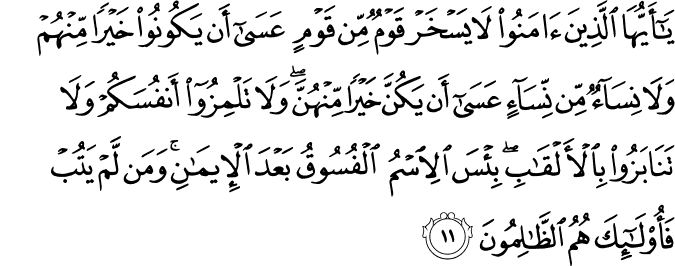
Surat Al-Ĥujurāt  Verse 11

O ye who believe! Let not some men among you laugh at others: It may be that the (latter) are better than the (former): Nor let some women laugh at others: It may be that the (latter are better than the (former): Nor defame nor be sarcastic to each other, nor call each other by (offensive) nicknames: Ill-seeming is a name connoting wickedness, (to be used of one) after he has believed: And those who do not desist are (indeed) doing wrong.
***********************************************************************************
Hadith - Bukhari's Book of Manners #329

... Ibn 'Abbas said, "If you wish to mention the faults of your friend, mention your own faults first."
************************************************************************************
Dawud :: Book 41 : Hadith 4870

Narrated Mu'awiyah:
I heard the Apostle of Allah (peace_be_upon_him) say: If you search for the faults of the people, you will corrupt them, or will nearly corrupt them. AbudDarda' said: These are the words which Mu'awiyah himself from the Apostle of Allah (peace_be_upon_him), and Allah benefited him by them.

**************************************************************************************

The Prophet (peace be upon him) asked us: "Do you know who is bankrupt?"

We replied: "The one among us who is bankrupt is someone who has neither gold nor silver nor any provision."

The Prophet (peace be upon him) then said: "Among my people, the one who is bankrupt is the one who -- after praying, fasting, and paying charity -- arrives on the Day of Judgment having cursed one person and slandered another, assaulted another, and misappropriated the wealth of someone else. Then those people will be given of his good deeds, and if his good deeds run out before redress is made, then some of their sins will be taken from them and put upon him. Then he will be cast into Hell.
(Related by Muslim and Tirmidhi)

 
**************************************************************************************

Facebook:
https://www.facebook.com/Lubna0zahid

For tutorials , females can add me on the below link (Exclusively for females)
https://www.facebook.com/LUBNA.ZAHID02


**************************************************************************************

The Importance of the Last Moments of Life (EMOTIONAL)


Come On brothers and sisters, let's promote this video, on facebook wall, groups, pages, twitter

Training oneself: Dealing with a bad Temper

Praise be to Allaah.

Anger is one of the evil whispers of Shaytaan, which leads to so many evils and tragedies, of which only Allaah knows their full extent. For this reason Islam has a great deal to say about this bad characteristic, and the Prophet (peace and blessings of Allaah be upon him) described cures for this "disease" and ways to limit its effects, among which are the following:

(1) Seeking refuge with Allaah from the Shaytaan:

Sulayman ibn Sard said: "I was sitting with the Prophet (peace and blessings of Allaah be upon him), and two men were slandering one another. One of them was red in the face, and the veins on his neck were standing out. The Prophet (peace and blessings of Allaah be upon him) said, ‘I know a word which, if he were to say it, what he feels would go away. If he said "I seek refuge with Allaah from the Shaytaan," what he feels (i.e., his anger) would go away.’" (Reported by al-Bukhaari, al-Fath, 6/337)

The Prophet (peace and blessings of Allaah be upon him) said: "If a man gets angry and says, ‘I seek refuge with Allaah,’ his anger will go away." (Saheeh al-Jaami’ al-Sagheer, no. 695)

(2) Keeping silent:

The Messenger of Allaah (peace and blessings of Allaah be upon him) said: "If any of you becomes angry, let him keep silent." (Reported by Imaam Ahmad, al-Musnad, 1/329; see also Saheeh al-Jaami’, 693, 4027).

This is because in most cases, the angry person loses self control and could utter words of kufr (from which we seek refuge with Allaah), or curses, or the word of divorce (talaaq) which would destroy his home, or words of slander which would bring him the enmity and hatred of others. So, in short, keeping silent is the solution which helps one to avoid all that.

(3) Not moving:

The Messenger of Allaah (peace and blessings of Allaah be upon him) said: "If any of you becomes angry and he is standing, let him sit down, so his anger will go away; if it does not go away, let him lie down."

The narrator of this hadeeth is Abu Dharr (may Allaah be pleased with him), and there is a story connected to his telling of it: he was taking his camels to drink at a trough that he owned, when some other people came along and said (to one another), "Who can compete with Abu Dharr (in bringing animals to drink) and make his hair stand on end?" A man said, "I can," so he brought his animals and competed with Abu Dharr, with the result that the trough was broken. [i.e., Abu Dharr was expecting help in watering his camels, but instead the man misbehaved and caused the trough to be broken]. Abu Dharr was standing, so he sat down, then he laid down. Someone asked him, "O Abu Dharr, why did you sit down then lie down?" He said: "The Messenger of Allaah (peace and blessings of Allaah be upon him) said: . . ." and quoted the hadeeth. (The hadeeth and this story may be found in Musnad Ahmad, 5/152; see also Saheeh al-Jaami’, no. 694).

According to another report, Abu Dharr was watering his animals at the trough, when another man made him angry, so he sat down . . . (Fayd al-Qadeer, al-Manaawi, 1/408)

Among the benefits of this advice given by the Prophet (peace and blessings of Allaah be upon him) is the fact that it prevents the angry person from going out of control, because he could strike out and injure someone, or even kill - as we will find out shortly - or he could destroy possessions and so on. Sitting down makes it less likely that he will become overexcited, and lying down makes it even less likely that he will do something crazy or harmful. Al-’Allaamah al-Khattaabi, may Allaah have mercy on him, said in his commentary on Abu Dawud: "One who is standing is in a position to strike and destroy, while the one who is sitting is less likely to do that, and the one who is lying down can do neither. It is possible that the Prophet (peace and blessings of Allaah be upon him) told the angry person to sit down or lie down so that he would not do something that he would later regret. And Allaah knows best." (Sunan Abi Dawud, with Ma’aalim al-Sunan, 5/141)

(4) Following the advice of the Prophet (peace and blessings of Allaah be upon him):

Abu Hurayrah, may Allaah be pleased with him, reported that a man said to the Prophet (peace and blessings of Allaah be upon him), "Advise me." He said, "Do not become angry." The man repeated his request several times, and each time the Prophet (peace and blessings of Allaah be upon him) told him, "Do not become angry." (Reported by al-Bukhaari, Fath al-Bari, 10/456)

According to another report, the man said: "I thought about what the Prophet (peace and blessings of Allaah be upon him) said, and I realized that anger combines all kinds of evil." (Musnad Ahmad, 5/373)

(5) Do not become angry and Paradise will be yours (a saheeh hadeeth, see Saheeh al-Jaami’, 7374. Ibn Hijr attributed it to al-Tabaraani, see al-Fath 4/465):

Remembering what Allaah has promised to the righteous (muttaqeen) who keep away from the causes of anger and struggle within themselves to control it, is one of the most effective ways of extinguishing the flames of anger. One of the ahaadeeth that describe the great reward for doing this is: "Whoever controls his anger at the time when he has the means to act upon it, Allaah will fill his heart with contentment on the Day of Resurrection." (Reported by al-Tabaraani, 12/453, see also Saheeh al-Jaami’, 6518).

Another great reward is described in the Prophet’s words: "Whoever controls his anger at the time when he has the means to act upon it, Allaah will call him before all of mankind on the Day of Resurrection, and will let him choose of the Hur al-’Iyn whoever he wants." (Reported by Abu Dawud, 4777, and others. It is classified as hasan in Saheeh al-Jaami, 6518).

(6) Knowing the high status and advantages offered to those who control themselves:

The Messenger of Allaah (peace and blessings of Allaah be upon him) said: "The strong man is not the one who can overpower others (in wrestling); rather, the strong man is the one who controls himself when he gets angry." (Reported by Ahmad, 2/236; the hadeeth is agreed upon). The greater the anger, the higher the status of the one who controls himself. The Prophet (peace and blessings of Allaah be upon him) said: "The strongest man is the one who, when he gets angry and his face reddens and his hackles rise, is able to defeat his anger." (Reported by Imaam Ahmad, 5/367, and classified as hasan in Saheeh al-Jaami’, 3859)

Anas reported that the Prophet (peace and blessings of Allaah be upon him) passed by some people who were wrestling. He asked, "What is this?" They said: "So-and-so is the strongest, he can beat anybody." The Prophet (peace and blessings of Allaah be upon him) said, "Shall I not tell you who is even stronger then him? The man who, when he is mistreated by another, controls his anger, has defeated his own shaytaan and the shaytaan of the one who made him angry." (Reported by al-Bazzaar, and Ibn Hijr said its isnaad is saheeh. Al-Fath, 10/519)

(7) Following the Prophet’s example in the case of anger:

The Prophet (peace and blessings of Allaah be upon him) is our leader and has set the highest example in this matter, as is recorded in a number of ahaadeeth. One of the most famous was reported by Anas, may Allaah be pleased with him, who said: "I was walking with the Messenger of Allaah (peace and blessings of Allaah be upon him), and he was wearing a Najraani cloak with a rough collar. A Bedouin came and seized him roughly by the edge of his cloak, and I saw the marks left on his neck by the collar. Then the Bedouin ordered him to give him some of the wealth of Allaah that he had. The Prophet (peace and blessings of Allaah be upon him) turned to him and smiled, then ordered that he should be given something." (Agreed upon. Fath al-Baari, 10/375)

Another way in which we can follow the example of the Prophet (peace and blessings of Allaah be upon him) is by making our anger for the sake of Allaah, when His rights are violated. This is the kind of anger which is praiseworthy. So the Prophet (peace and blessings of Allaah be upon him) became angry when he was told about the imaam who was putting people off the prayer by making it too long; when he saw a curtain with pictures of animate creatures in ‘Aa’ishah’s house; when Usaamah spoke to him about the Makhzoomi woman who had been convicted of theft, and he said "Do you seek to intervene concerning one of the punishments prescribed by Allaah?"; when he was asked questions that he disliked, and so on. His anger was purely for the sake of Allaah.

(8) Knowing that resisting anger is one of the signs of righteousness (taqwaa):

The righteous (al-muttaqoon) are those praised by Allaah in the Qur’aan and by His Messenger (peace and blessings of Allaah be upon him). Paradise as wide as heaven and earth has been prepared for them. One of their characteristics is that they (interpretation of the meaning) "spend (in Allaah’s Cause) in prosperity and in adversity, [they] repress anger, and [they] pardon men; verily, Allaah loves al-muhsinoon (the good-doers)." [Aal ‘Imraan 3:134]

These are the ones whose good character and beautiful attributes and deeds Allaah has mentioned, and whom people admire and want to emulate. One of their characteristics is that (interpretation of the meaning) ". . . when they are angry, they forgive." [al-Shooraa 42:47]

(9) Listening to reminders:

Anger is a part of human nature, and people vary in their anger. It may be difficult for a man not to get angry, but sincere people will remember Allaah when they are reminded, and they will not overstep the mark. Some examples follow:

Ibn ‘Abbaas (may Allaah be pleased with him) reported that a man sought permission to speak to ‘Umar ibn al-Khattaab (may Allaah be pleased with him), then he said: "O son of al-Khattaab, you are not giving us much and you are not judging fairly between us." ‘Umar (may Allaah be pleased with him) was so angry that he was about to attack the man, but al-Hurr ibn Qays, who was one of those present, said: "O Ameer al-Mu’mineen, Allaah said to His Prophet (peace and blessings of Allaah be upon him) (interpretation of the meaning): ‘Show forgiveness, enjoin what is good, and turn away from the foolish’ [al-A’raaf 7:199]. This man is one of the foolish." By Allaah, ‘Umar could go no further after al-Hurr had recited this aayah to him, and he a man who was careful to adhere to the Book of Allaah. (Reported by al-Bukhaari, al-Fath, 4/304).

This is how the Muslim should be. The evil munaafiq (hypocrite) was not like this when he was told the hadeeth of the Prophet (peace and blessings of Allaah be upon him) and one of the Companions said to him, "Seek refuge with Allaah from the Shaytaan." He said to the one who reminded him, "Do you think I am crazy? Go away!" (Reported by al-Bukhaari, al-Fath, 1/465). We seek refuge with Allaah from failure.

(10) Knowing the bad effects of anger:

The negative effects of anger are many; in short they cause damage to one’s own self and to others. The angry person may utter words of slander and obscenity, he may attack others (physically) in an uncontrolled manner, even to the point of killing. The following story contains a valuable lesson:

‘Ilqimah ibn Waa’il reported that his father (may Allaah be pleased with him) told him: "I was sitting with the Prophet (peace and blessings of Allaah be upon him) when a man came to him leading another man by a rope. He said, ‘O Messenger of Allaah, this man killed my brother.’ The Messenger of Allaah (peace and blessings of Allaah be upon him) asked him, ‘Did you kill him?’ He said, ‘Yes, I killed him.’ He asked, ‘How did you kill him?’ He said, ‘He and I were hitting a tree to make the leaves fall, for animal feed, and he slandered me, so I struck him on the side of the head with an axe, and killed him.’ . . ." (Reported by Muslim, 1307, edited by al-Baaqi).

Anger could lead to less than killing, such as wounding and breaking bones. If the one who caused the anger runs away, the angry person turns his anger in on himself, so he may tear his clothes, or strike his cheeks, or have a fit, or fall unconscious, or he may break dishes and plates, or break furniture.

In the worst cases, anger results in social disasters and the breaking of family ties, i.e., divorce. Ask many of those who divorced their wives, and they will tell you: it was in a moment of anger. This divorce results in misery for the children, regret and frustration, a hard and difficult life, all as a result of anger. If they had remembered Allaah, come to their senses, restrained their anger and sought refuge with Allaah, none of this would have happened. Going against the sharee’ah only results in loss.

The damage to health that results from anger can only be described by doctors, such as thrombosis, high blood pressure, tachycardia (abnormally rapid heartbeat) and hyperventilation (rapid, shallow breathing), which can lead to fatal heart attacks, diabetes, etc. We ask Allaah for good health.

(11) The angry person should think about himself during moments of anger:

If the angry person could see himself in the mirror when he is angry, he would hate himself and the way he looks. If he could see the way he changes, and the way his body and limbs shake, how his eyes glare and how out of control and crazy his behaviour is, he would despise himself and be revolted by his own appearance. It is well-known that inner ugliness is even worse than outer ugliness; how happy the Shaytaan must be when a person is in this state! We seek refuge with Allaah from the Shaytaan and from failure.

(12) Du’aa’:

Du’aa’ is always the weapon of the believer, whereby he asks Allaah to protect him from evil, trouble and bad behaviour and seeks refuge with Him from falling into the pit of kufr or wrongdoing because of anger. One of the three things that can help save him is: being fair at times of contentment and of anger (Saheeh al-Jaami’, 3039). One of the du’aa’s of the Prophet (peace and blessings of Allaah be upon him) was:

"O Allaah, by Your knowledge of the Unseen and Your power over Your creation, keep me alive for as long as You know life is good for me, and cause me to die when You know death is good for me. O Allaah, I ask You to make me fear You in secret and in public, and I ask You to make me speak the truth in times of contentment and of anger. I ask You not to let me be extravagant in poverty or in prosperity. I ask You for continuous blessings, and for contentment that does not end. I ask You to let me accept Your decree, and for a good life after death. I ask You for the joy of seeing Your face and for the longing to meet You, without going through diseases and misguiding fitnah (trials). O Allaah, adorn us with the adornment of faith and make us among those who are guided. Praise be to Allaah, the Lord of the Worlds."

Islam Q&A
Sheikh Muhammed Salih Al-Munajjid

Training oneself: Slandering callers and reformers

Praise be to Allaah.

Allaah has enjoined justice and good treatment of others, and He has forbidden wrongdoing, hatred and enmity. Allaah sent His Prophet Muhammad (peace and blessings of Allaah be upon him) with the same message as He sent all the Messengers, namely the call to Tawheed and to worship of Allaah alone. He commanded him to establish justice and forbade him to do the opposite, i.e., to worship anything other than Allaah, to cause division and to transgress against the rights of others.

In these days it has become very common that people who claim to have knowledge and to be calling people to good slander many of their brothers among the well-known daa’iyahs, and they talk about the seekers of knowledge, daa’iyahs and lecturers. They do that in secret in their own gatherings, but it may be recorded on tapes that are distributed among the people, and they may do it openly in public lectures in the mosques. This behaviour goes against the commands of Allaah and His Messenger in several ways.

1 – It is a transgression against the rights of the Muslims, and against the elite of the people, namely the seekers of knowledge and daa’iyahs who are striving to make the people aware and to teach them and correct their beliefs and practices, and to organize lessons and lectures, and to write beneficial books.

2 – It splits the Muslims and causes division in their ranks. They are the most in need of unity and they need to keep away from division, discord and too much gossip amongst themselves, especially when the daa’iyahs who are being slandered are from among the Ahl al-Sunnah wa’l-Jamaa’ah who are well known for their opposition to bid’ah (innovation) and myth, and for standing up against those who promote such things, and for exposing their plots and tricks. We see no benefit to be gained by such actions, except for the enemies who lie in wait for opportunities to harm the Muslims, such as the kaafirs, hypocrites and followers of bid’ah and misguidance.

3 – This action offers support and help for the self-serving among the secularists, westernizers and other heretics who are well known for stirring up trouble among the daa’iyahs and telling lies against them, and inciting people against them in their writings and recordings. It is contrary to Islamic brotherhood for those who are too hasty to help their enemies against their brothers among the seekers of knowledge, daa’iyahs and others.

4 – This spreads corrupts ideas in the hearts and minds of the common folk and elite; it spreads and propagates lies and false rumours, and causes a great deal of backbiting and slander. It leaves the door wide open to evil people who persist in spreading doubts and stirring up fitnah, and who are keen to cause harm to the believers by accusing them of things that they did not do.

5 – Much of what is being said has no basis in reality; rather these are illusions which the Shaytaan has made attractive to them, through which he has tempted them. Allaah says (interpretation of the meaning):

“O you who believe! Avoid much suspicion; indeed some suspicions are sins. And spy not, neither backbite one another…”[al-Hujuraat 49:12]

The believer should interpret what his Muslim brother says in the best possible way. One of the salaf said: Never think of something that is said by your brother as being bad when you still find room for a good interpretation.

6 – Whatever ijtihaad is produced by some scholars or seekers of knowledge, in areas where ijtihaad is permitted, the author of said ijtihaad cannot be blamed or rebuked for it, so long as he is qualified to engage in ijtihaad. If someone else has a different opinion, it is better for him to debate with him in a proper manner, striving to reach the truth via the shortest route and leaving no room for the insinuating whispers of the Shaytaan or for him to cause trouble among the believers. If that is not possible, and someone thinks that he has no choice but to explain what is wrong with his ijtihaad, then he should choose the best wording and the most subtle way of explaining, and not resort to attacking, slandering or going to extremes in criticizing him, which may cause others to reject the truth or to turn away from it. He should also avoid criticizing specific people, casting aspersions upon their intentions or saying unnecessary or irrelevant things about them. In such cases the Messenger (peace and blessings of Allaah be upon him) would say, “What is the matter with some people who say such and such…?”

The advice I offer to these brothers who have fallen into the sin of slandering the daa’iyahs is to repent to Allaah for the things that they have written or said that may have corrupted the hearts of some youth and filled them with hatred and grudges, and kept them from seeking beneficial knowledge or from calling people to Allaah by making them preoccupied with gossip and talking about this one and that one, and seeking out faults for which they could criticize people, and going to extremes in doing that.

I also advise them to offer expiation for the things that they have done by writing and other means that they think they should not have done, and to remove from people’s minds the wrong ideas they may have given them. They should focus on fruitful actions which will bring them closer to Allaah and will be beneficial to people, and they should beware of being too hasty to accuse people of kufr, fisq and bid’ah without any clear evidence or proof. The Prophet (peace and blessings of Allaah be upon him) said: “Whoever says to his brother ‘O kaafir!’ one of them will be deserving of that description.” (Saheeh, agreed upon).

It is prescribed for those who call others to the truth and for seekers of knowledge, if they are uncertain about something said by a scholar or anyone else, to refer to the prominent scholars and to ask them, so that they can explain the facts of the matter to them and remove the confusion and doubt from their minds, in accordance with the words of Allaah in Soorat al-Nisaa’ (interpretatiuon of the meaning):

“When there comes to them some matter touching (public) safety or fear, they make it known (among the people); if only they had referred it to the Messenger or to those charged with authority among them, the proper investigators would have understood it from them (directly). Had it not been for the Grace and Mercy of Allaah upon you, you would have followed Shaytaan (Satan), save a few of you”[al-Nisaa’ 4:83]

And Allaah is the One Whom we ask to reform all the Muslims and to unite their hearts in taqwa and to bring the scholars of the Muslims and those who call to the truth together in doing that which pleases Him and will benefit His slaves. May He unite them in following guidance and protect them against all the causes of division and dissent; may He support the truth through them and humiliate falsehood through them, for He is the One Who is able to do that. May Allaah bless our Prophet Muhammad and his family and companions, and those who follow his guidance until the Day of Resurrection.

Majmoo’ Fataawa wa Maqaalaat Mutanawwi’ah li Samaahat al-Shaykh ‘Abd al-‘Azeez ibn ‘Abd-Allaah ibn Baaz (may Allaah have mercy on him), vol. 7, p. 311.

http://islamqa.com/en/ref/21576

Training oneself: Ways to help oneself pray Qiyaam al-Layl or tahajjud ?

Praise be to Allaah.


There are many things that one can do to help oneself pray qiyaam al-layl, among which are the following:


1 – Being sincere towards Allaah, as He has commanded us to be sincere towards Him and none other in our deeds. He tells us (interpretation of the meaning): “And they were commanded not, but that they should worship Allaah, and worship none but Him Alone…” [al-Bayyinah 98:5]. The more sincere a person is towards Allaah, the more he will be guided and helped to obey Allaah and draw closer to Him. Ubayy ibn Ka’b (may Allaah be pleased with him) reported that the Prophet (peace and blessings of Allaah be upon him) said: “Give glad tidings to this ummah of splendour, religion, high rank, victory and prevalence on earth. Whoever does the deeds of the Hereafter to gain some worldly benefit, will have no share of the Hereafter.” (Reported by Ahmad. Saheeh al-Jaami’, 2825). Mutarraf ibn ‘Abd-Allaah ibn al-Shakheer said: “The goodness of a deed is related to the goodness of the heart, and the goodness of the heart is related to the goodness of the intention.” Ibn al-Qayyim (may Allaah have mercy on him) said: “The degree to which a person is helped and aided by Allaah depends on the degree of his intention, drive, aim and hopes. Help from Allaah comes to people in proportion to their drive, intention, hopes and fears, and failure comes to them in like manner.”


Therefore the salaf were very keen to conceal their acts of worship such as qiyaam al-layl. A man asked Tameem ibn Aws al-Daari (may Allaah be pleased with him), ‘How do you pray at night?’ He got very angry and said, ‘By Allaah, one rak’ah that I pray in secret in the small hours of the night is more beloved to me than praying the whole night long and then telling people about it.’ Ayyoob al-Sakhtiyaani used to spend the entire night in prayer, then when dawn approached, he would go back to bed and lie down, and when dawn came, he would raise his voice as if he had just woken up.


2 – The person who wants to pray qiyaam al-layl should realize that Allaah is calling him to qiyaam. When the slave realizes that his Master, Who has no need of people’s worship, is calling him to do this, he will respond. Allaah says (interpretation of the meaning): “O you wrapped in your garments (i.e., Prophet Muhammad)! Stand (to pray) all night, except a little. Half of it, or a little less than that, or a little more; and recite the Qur’aan (aloud) in a slow, (pleasant tone and) style.” [al-Muzzammil 73:1-4].


Sa’d ibn Hishaam ibn ‘Aamir said to ‘Aa’ishah (may Allaah be pleased with her): “Tell me about how the Messenger of Allaah (peace and blessings of Allaah be upon him) prayed qiyaam.” She said: “Have you not read “Yaa ayyuha’l-muzzammil (O you wrapped in your garments!)?” He said, “Of course.” She said: “Allaah, may He be exalted and glorified, made qiyaam obligatory at the beginning of this soorah, so the Prophet (peace and blessings of Allaah be upon him) and his companions prayed qiyaam for a year, and Allaah withheld the end of this soorah for twelve months, until He revealed something at the end of this soorah to make things easier, so qiyaam al-layl became voluntary after it had been obligatory.” (Reported by Muslim).


3 – Knowing the virtues of qiyaam al-layl. Whoever knows the virtues of this act of worship will be keen to talk to Allaah, may He be exalted, and to stand before Him at that time. Among the reports that describe the virtues of this act of worship is the hadeeth of Abu Hurayrah (may Allaah be pleased with him), in which the Prophet (peace and blessings of Allaah be upon him) said: “The best of prayers after the prescribed prayers is prayer in the depths of the night, and the best of fasting after the month of Ramadaan is fasting the month of Allaah, Muharram.” (reported by Muslim).


‘Abd-Allaah ibn ‘Amr (may Allaah be pleased with them both) reported that the Prophet (peace and blessings of Allaah be upon him) said: “The most beloved of prayer to Allaah is the prayer of Dawood, and the most beloved of fasts to Allaah is the fast of Dawood. He used to sleep for half of the night, then get up and pray for a third of the night, then sleep for a sixth of the night, and he used to fast every other day.” (Agreed upon).


‘Amr ibn ‘Absah reported that the Prophet (peace and blessings of Allaah be upon him) said: “The closest that the Lord is to His slave is in the later part of the night, so if you can be one of those who remember Allaah at that time, then do so.” (Reported by al-Tirmidhi and al-Nisaa'i).


According to a hadeeth narrated by Ibn Mas’ood (may Allaah be pleased with him), the Prophet (peace and blessings of Allaah be upon him) said: “Our Lord admires two men: a man who leaves his mattress and cover, and slips away from his wife and lover, to go and pray. Allaah says, ‘O My angels, look at My slave. He has left his mattress and cover and slipped away from his lover and wife to pray, our of hope for what is with Me and out of fear of what is with Me.” (Reported by Ahmad. It is a hasan report. Saheeh al-Targheeb, 258).


Qiyaam al-Layl expels forgetfulness from the heart, as is stated in the hadeeth narrated by ‘Abd-Allaah ibn ‘Amr ibn al-‘Aas (may Allaah be pleased with them both), in which the Prophet (peace and blessings of Allaah be upon him) said: “Whoever recites ten aayaat in qiyaam will not be recorded as one of the forgetful. Whoever recites a hundred aayaat in qiyaam will be recorded as one of the devout [???], and whoever prays a thousand aayaat in qiyaam will be recorded as one of the muqantareen (those who pile up good deeds).” (Reported by Abu Dawood and Ibn Hibbaan. It is a hasan report. Saheeh al-Targheeb, 635).


Yahyaa ibn Mu’aadh said: “The medicine of the heart is five things: reading Qur’aan and pondering the meaning, having an empty stomach, praying at night (qiyaam al-layl), beseeching Allaah at the time of suhoor, and keeping company with righteous people.”


4 – Studying how the salaf and righteous people practised qiyaam al-layl and adhered to it. The salaf used to enjoy qiyaam al-layl and rejoice greatly in doing it. ‘Abd-Allaah ibn Wahb said: “Every type of pleasure is enjoyed only once, except for acts of worship, which are enjoyed three times: when you do it, when you remember it, and when you are given the reward for it.”


Muhammad ibn al-Munkadir said: “There is nothing left of the joys of this life except three: qiyaam al-layl, meeting one’s brothers in faith, and praying in congregation.”


Thaabit al-Banaani said: “There is nothing I enjoy more than qiyaam al-layl.”


Yazeed al-Riqaashi said: “A lot of tahajjud brings delight to the worshippers, and a lot of thirst (i.e., fasting), brings joy when they meet Allaah.”


Mukhallad ibn Husayn said: “I never woke up at night except I saw Ibraaheem ibn Adham remembering Allaah and praying, and this made me depressed, so I consoled myself with this aayah (interpretation of the meaning): ‘…That is the Grace of Allaahm which He bestows on whom He pleases. And Allaah is the Owner of Great Bounty’ [al-Hadeed 54:21].”


Abu ‘Aasim al-Nabeel said: “Abu Haneefah used to be called al-Watad (pole or pillar) because he prayed so much.”


Al-Qaasim ibn Ma’een said: “Abu Haneefah spent an entire night in qiyaam reciting this aayah (interpretation of the meaning): ‘Nay, but the Hour is their appointed time (for their full recompense), and the Hour will be more grievous and more bitter’ [al-Qamar 54:46], repeating it and weeping, beseeching Allaah until morning came.”


Ibraaheem ibn Shammaas said: “I used to see Ahmad ibn Hanbal staying up at night to pray when he was a young man.”


Abu Bakr al-Marwadhi said: “I was with Imaam Ahmad for nearly four months in the army, and he never stopped praying qiyaam at night or reading Qur’aan during the day, and I never knew when he completed the Qur’aan, because he kept that secret.”


Imaam al-Bukhaari used to pray qiyaam and tahajjud at night until the time of suhoor, and he would read between a half and a third of the Qur’aan, and complete it at suhoor every third night.


Al-‘Allaamah Ibn ‘Abd al-Haadi said, describing the qiyaam of Shaykh al-Islam Ibn Taymiyah: “At night he would keep away from people, and spend that time only with his Lord, beseeching Him continually and reciting Qur’aan, repeating different kinds of acts of worship by night and by day. When he began to pray, his body would start to tremble, leaning to the left and right.”


Ibn Rajab said concerning his shaykh Imaam Ibn al-Qayyim: “He was a man of worship, tahajjud and lengthy prayers. I have never seen his equal in worship and knowledge of the Qur’aan, hadeeth and principles of faith.”


Al-Haafiz Ibn Hajar said, describing his shaykh al-Haafiz al-‘Iraaqi: “I stayed with him, and I never saw him forsake qiyaam al-layl: it was like a habit for him.”


5 – Sleeping on one’s right side. The Prophet (peace and blessings of Allaah be upon him) taught his ummah to sleep on their right sides, as is reported in the hadeeth of Abu Hurayrah (may Allaah be pleased with him), who said that the Prophet (peace and blessings of Allaah be upon him) said: “When any one of you goes to bed, let him clear his bed by hitting it with his garment, for he does not know what may have come onto it. Then let him lie down on his right side, then let him say, ‘Bismika Rabbi wada’tu janbi wa bika arfa’uhu. In amsakta nafsi farhamhaa wa in arsaltahaa fahfazhaa bimaa tahfazu bihi ‘ibaadaka al-saaliheen (In Your Name, my Lord, I lay myself down and I get up again. If You take my soul, then have mercy on it, and if You send it back to me, then protect it with that with which You protect Your righteous slaves).’” (Agreed upon).


Al-Baraa’ ibn ‘Aazib (may Allaah be pleased with him) reported that the Prophet (peace and blessings of Allaah be upon him) said: “When you want to go to bed, do wudoo’ as for prayer, then lie down on your right side.” (Agreed upon)


Hafsah (may Allaah be pleased with her) said: “When the Prophet (peace and blessings of Allaah be upon him) went to bed, he would put his right hand under his right cheek.” (Reported by al-Tabaraani, Saheeh al-Jaami’, 4523).


Imaam Ibn al-Qayyim (may Allaah have mercy on him) said: “There is a reason for his lying on his right side, which is that the heart is located on the left, so if a person lays on his left side, he will sleep too deeply, because the heart’s position will be too comfortable, but if he sleeps on his right side, he will not be too settled, so he won’t sleep deeply.”


6 – Sleeping in a state of tahaarah (purity). We have already quoted the hadeeth of al-Baraa’ ibn ‘Aazib (may Allaah be pleased with him), in which the Prophet (peace and blessings of Allaah be upon him) said, “When you go to bed, do wudoo’ as if for prayer.” (Agreed upon).


Mu’aad ibn Jabal (may Allaah be pleased with him) reported that the Prophet (peace and blessings of Allaah be upon him) said: “There is no Muslim who goes to sleep remembering Allaah and in a state of purity, and when he turns over he asks Allaah for good in this world and the next, but it will be given to him.” (Reported by Abu Dawood and Ahmad. Saheeh al-Jaami’, 5754).


Ibn ‘Abbaas (may Allaah be pleased with them both) reported that the Prophet (peace and blessings of Allaah be upon him) said: “Purify these bodies and Allaah will purify you, for there is no slave who goes to sleep in a state of purity but an angel spends the night with him, and every time he turns over, [the angel] says, ‘O Allaah, forgive Your slave, for he went to bed in a state of purity.’” (Reported by al-Tabaraani. Al-Mundhiri said, its isnaad is jaayid. Saheeh al-Jaami’, 3831).


7 – Going to sleep early. Sleeping straight after ‘Ishaa’ is the advice of the Prophet (peace and blessings of Allaah be upon him), and a good and healthy habit. One of the ahaadeeth that describe its virtues was narrated by Abu Barzah al-Aslami (may Allaah be pleased with him) who said that the Prophet (peace and blessings of Allaah be upon him) used to prefer to delay ‘Ishaa’, and he did not like to sleep before it or talk after it. (Reported by al-Bukhaari).


Al-Haafiz Ibn Hajar reported that al-Qaadi ‘Ayaad said, concerning the phrase “He did not like to sleep before it”: “Because that could lead to one praying it too late, or delaying it until after the preferred time, and talking after it could lead to one sleeping before Fajr and missing it, or missing qiyaam al-layl.”


Ibn Raafi’ said: “ ‘Umar ibn al-Khattaab (may Allaah be pleased with him) used to wave his stick at the people when darkness fell, and would say, ‘Get up and go, may Allaah help you to pray qiyaam at night!’”


Another matter that has to do with sleep is choosing a suitable bed, not one that is excessively luxurious or soft, because that makes a person sleep too much and become negligent, and causes laziness and carelessness. ‘Aa’ishah (may Allaah be pleased with her) said: “The pillow of the Prophet (peace and blessings of Allaah be upon him) on which he slept at night was made of leather stuffed with palm fibres.” (Reported by Abu Dawood and Ahmad. Saheeh al-Jaami’, 4714).


Ibn ‘Abbaas (may Allaah be pleased with him) reported that ‘Umar ibn al-Khattaab entered upon the Messenger of Allaah (peace and blessings of Allaah be upon him) when he was lying on a mat of palm fibres that had left marks on his side. ‘Umar said, “O Messenger of Allaah, why do you not get something more comfortable than this?” He (peace and blessings of Allaah be upon him) said: “What do I have to do with this world? My relationship with this world is like that of a traveller on a hot summer’s day, who seeks shade under a tree for an hour, then moves on.” (Reported by Ahmad and al-Haakim. Saheeh al-Jaami’, 5545).


‘Ali ibn Bakkaar (may Allaah have mercy on him) used to have a slave-woman who would spread out his bed for him, and he would touch it with his hand and say: “By Allaah, you are good, and by Allaah you are cool, but by Allaah I will not rest on you tonight.” Then he would get up and pray qiyaam until Fajr.


Also, one should not sleep too much or too deeply. Ibraaheem ibn Adham said: “If you are sleeping at night, and running about during the day, and always committing sin, how can you earn the pleasure of the One Who is directing your affairs?”


8 – Having the habit of reciting adhkaar prescribed by sharee’ah before going to sleep, because these adhkaar are like a fortress which protects a person from the Shaytaan, by the permission of Allaah, and helps him to get up for qiyaam. Among these adhkaar is that mentioned in the hadeeth of Abu Hurayrah (may Allaah be pleased with him), who said that the Prophet (peace and blessings of Allaah be upon him) said: “When any one of you goes to bed, let him clear his bed by hitting it with his garment, for he does not know what may have come onto it. Then let him lie down on his right side, then let him say, ‘Bismika Rabbi wada’tu janbi wa bika arfa’uhu. In amsakta nafsi farhamhaa wa in arsaltahaa fahfazhaa bimaa tahfazu bihi ‘ibaadaka al-saaliheen (In Your Name, my Lord, I lay myself down and I get up again. If You take my soul, then have mercy on it, and if You send it back to me, then protect it with that with which You protect Your righteous slaves).’” (Agreed upon).


‘Aa’ishah (may Allaah be pleased with her) reported that when the Prophet (peace and blessings of Allaah be upon him) went to bed each night, he would put his palms together, blow in them, and recite Qul huwa Allaahu ahad, Qul a’oodhu bi Rabbi’l-Falaq and Qul a’oodhu bi Rabbi’l-Naas, then he would wipe as much of his body as he could with his hands, starting with his head and face, and the front of his body, doing this three times. (Agreed upon).


Ibn Mas’ood (may Allaah be pleased with him) reported that the Prophet (peace and blessings of Allaah be upon him) said: “Whoever recites the last two aayahs of Soorat al-Baqarah, this will take care of him.” (Agreed upon).


Anas ibn Maalik (may Allaah be pleased with him) reported that when the Prophet (peace and blessings of Allaah be upon him) went to bed, he would say: “Al-hamdu Lillaah illadhi at’amanaa wa saqaanaa, wa kafaanaa fa kam mimman laa kaafeeya lahu wa laa mu’weeya lahu (Praise be to Allaah Who has fed us and given us to drink, and Who has given us enough, for how many are there who have no-one to suffice them or give them refuge).” (Reported by Muslim).


According to the hadeeth of Abu Hurayrah in which he tells the story of how he captured the Shaytaan, the Shaytaan said to him: “When you go to bed, recite Aayat al-Kursi, ‘Allaah! None has the right to be worshipped but He, the Ever-Living, the One Who sustains and protects all that exists…’ [al-Baqarah 2:255 – interpretation of the meaning] until the end of it, because it will bring Allaah’s protection for you, and no shaytaan will approach you until morning comes.” Abu Hurayrah (may Allaah be pleased with him) mentioned this to the Prophet (peace and blessings of Allaah be upon him), and he said, “He spoke the truth even though he is a liar.” (Agreed upon).


‘Ali ibn Abi Taalib (may Allaah be pleased with him) reported that when the Prophet’s daughter Faatimah (may Allaah be pleased with her) came to him and asked him for a servant, he (peace and blessings of Allaah be upon him) said to her and ‘Ali: “Shall I not teach you something that will be better for you than a servant? When you go to bed, say ‘Subhaan Allaah’ thirty-three times, ‘al-hamdu Lillaah’ thirty-three times, and ‘Allaahu akbar’ thirty-four times. This is better for you than a servant.” (Agreed upon).


Anas ibn Maalik (may Allaah be pleased with him) reported that the Prophet (peace and blessings of Allaah be upon him) said: “Recite ‘Qul yaa ayyuha’l-kaafiroon’ when you go to sleep, for it is a renunciation of shirk.” (Reported by al-Bayhaqi. Saheeh al-Jaami’, 1172).


Hafsah (may Allaah be pleased with her) reported that when the Prophet (peace and blessings of Allaah be upon him) went to bed, he would put his right hand under his right cheek and say: ‘Rabbi qinee ‘adhaabaka yawma tab’athu ‘ibaadaka (My Lord, save me from Your punishment on the Day when You resurrect Your slaves).’” (Reported by Abu Dawood, Saheeh al-Jaami’, 4532).


Al-Baraa’ ibn ‘Aazib (may Allaah be pleased with him) reported that the Prophet (peace and blessings of Allaah be upon him) said: “When you go to bed, do wudoo’ as if for prayer, then lie down on your right side, then say: ‘Allaahummah aslamtu nafsi ilayk, wa wajahtu wajhi ilayk, wa fawwadtu amri ilayk, wa alja’tu zahri ilayk, raghbatan wa rahbatan ilayk, laa malja’a wa laa manjaa minka illa ilayk. Aamantu bi kitaabik alladhi anzalt, wa bi nabiyyik alladhi arsalt (O Allaah, I submit myself to You, I turn my face to You, I delegate my affairs to You and I rely totally on You, out of fear and hope of You. There is no refuge or sanctuary from You except in You. I believe in Your Book which You have revealed and in Your Prophet whom You have sent).’ Then if you die, you will have died on the fitrah, so make these the last words you speak.” (Agreed upon).


Similarly, the Muslim should have the habit of reciting adhkaar prescribed by sharee’ah when waking up, such as that reported by Abu Hurayrah, who said that the Prophet (peace and blessings of Allaah be upon him) said: “When any one of you wakes up, he should say: ‘Al-hamdu Lillaah illadhi radda ‘alayya roohi, wa ‘aafaani fi jasadi wa adhina li bi dhikrihi (Praise be to Allaah Who has restored my soul, given health to my body, and allowed me to remember Him).” (Reported by al-Tirmidhi and al-Nisaa'i, Saheeh al-Jaami’, 326).


‘Ubaadah ibn al-Saamit (may Allaah be pleased with him) reported that the Prophet (peace and blessings of Allaah be upon him) said: “Whoever turns over at night and says ‘Laa ilaaha ill-Allaah wahdahu laa shareeka lah, lahu’l-mulk wa lahu’l-hamd wa huwa ‘a’l kulli shay’in qadeer. Al-hamdulillahi, subhaan Allaah wa laa illaaha ill-Allaah wa Allaahu akbar wa laa hawla wa laa quwwata illa Billaah (There is no god but Allaah Alone, with no partner or associate. His is the Dominion and the Praise, and He is Able to do all things. Praise be to Allaah, glory be to Allaah. There is no god except Allaah, Allaah is Most Great and there is no strength and no power except in Allaah),’ then says, ‘Allaahumma ‘ghfir li (O Allaah, forgive me),’ or some other du’aa’, it will be answered, and if he does wudoo’ and then prays, his prayer will be accepted.” (Reported by al-Bukhaari)


Imaam Ibn Battaal said: “Allaah has promised through His Prophet (peace and blessings of Allaah be upon him) that whoever wakes up from his sleep pronouncing words of Tawheed, submitting to His sovereignty, recognizing His blessings by praising Him, exalting Him above that which does not befit Him by glorifying Him (saying ‘Subhaan Allaah’), submitting to Him by magnifying Him (saying ‘Allaahu akbar’) and admitting one’s utter dependence upon His help, then if he makes du’aa’ it will be answered, and if he prays his prayer will be accepted. Everyone who hears this hadeeth should apply it and make the most of it, and make his intention sincerely for his Lord, may He be glorified and exalted.”


Al-Baraa’ ibn ‘Aazib (may Allaah be pleased with them both) said: “When the Prophet (peace and blessings of Allaah be upon him) woke up, he would say: ‘Al-hamdu Lillaah illadhi ahyaanaa ba’da maa amaatanaa wa ilayhi al-nushoor (Praise be to Allaah Who has brought us back to life after having caused us to die, and unto Him is the resurrection).’” (Reported by Muslim).


Ibn ‘Abbaas (may Allaah be pleased with them both) reported that when the Prophet (peace and blessings of Allaah be upon him) woke up he would wipe the sleep from his face with his hand, then look at the sky and recite the final ten aayaat of Soorat Aal ‘Imran: “Verily, in the creation of the heavens and the earth…” [Aal ‘Imraan 3:190 – interpretation of the meaning].” (Reported by Muslim)


Imaam al-Nawawi said: “This indicates that it is mustahabb to wipe away the traces of sleep from one’s face, and to recite these aayaat when getting up from sleep.”


9 – Being keen to take a nap or siesta during the day, whether before zuhr or after. Anas (may Allaah be pleased with him) reported that the Prophet (peace and blessings of Allaah be upon him) said: “Take a nap, for the shayaateen do not take naps.” (Reported by al-Tabaraani. Al-Saheehah, 2647).


Ishaaq ibn ‘Abd-Allaah said: “Taking a nap is one of the deeds of good people. It revitalizes the heart and helps one to pray qiyaam al-layl.”


Al-Hasan al-Basri passed by a group of people in the marketplace in the middle of the day, and heard the racket they were making. He said, “Do these people take a nap?” It was said to him, “No.” He said, “I think their nights must be bad.”


10 – Avoiding eating or drinking too much. Eating and drinking too much are two of the main obstacles that prevent people from praying qiyaam al-layl. Al-Miqdaam ibn Ma’d Yakrib (may Allaah be pleased with him) reported that the Prophet (peace and blessings of Allaah be upon him) said: “Man fills no vessel worse than his stomach. It is sufficient for the son of Adam to have a few mouthfuls to give him the strength he needs. If he has to fill his stomach, then let him leave one-third for food, one-third for drink and one-third for air.” (Reported by al-Tirmidhi and Ibn Maajah. Saheeh al-Jaami’, 5674).


Abu Juhayfah (may Allaah be pleased with him) reported that the Prophet (peace and blessings of Allaah be upon him) said to a man who burped in his presence: “Stop your burping, for the people who eat the most in this life will be the most hungry hungry on the Day of Resurrection.” (Reported by al-Haakim. Saheeh al-Jaami’, 1190).


Sufyaan al-Thawri said: “You should eat little, so that you will be able to pray qiyaam al-layl.”


Ma’qal ibn Habeeb saw some people eating a lot, and said, ‘I do not think that our companions want to pray qiyaam al-layl.”


Wahb ibn Munbih said: “There is no son of Adam dearer to his shaytaan than the one who eats and sleeps a lot.”


11 – Striving against oneself to pray qiyaam al-layl. This is one of the best means of helping oneself to pray qiyaam, because human nature is inclined towards wrongdoing, so the one who follows his own inclinations will be led to doom and destruction. Allaah has commanded us to strive against our own selves, as He says (interpretation of the meanings):


“And strive hard in Allaah’s Cause as you ought to strive…” [al-Hajj 22:78]


“And as for those who strive hard in Our Cause, We will surely guide them to Our Paths. And verily, Allaah is with the muhsinoon (good-doers).” [al-‘Ankaboot 29:69]


“Their sides forsake their beds, to invoke their Lord in fear and hope, and they spend (charity in Allaah’s Cause) out of what We have bestowed on them” [al-Sajdah 32:16]


Fadaalah ibn ‘Ubayd (may Allaah be pleased with him) reported that the Prophet (peace and blessings of Allaah be upon him) said: “The mujaahid is the one who strives against his own self for the sake of Allaah.” (Reported by al-Tirmidhi and Ibn Hibbaan. Al-Saheehah, 549).


According to the hadeeth of ‘Uqbah ibn ‘Aamir (may Allaah be pleased with him), the Prophet (peace and blessings of Allaah be upon him) said: “When a man from my ummah gets up to pray at night, striving against his own self to get up and purify himself, there are knots on him. When he washes his hands in wudoo’, one knot is undone. When he washes his face, another knot is undone. When he wipes his head another knot is undone. When he washes his feet, another knot is undone. Then Allaah says to those who are veiled (in the Unseen): ‘Look at this slave of Mine, he is striving against his own self and asking of Me. Whatever My slave asks of Me shall be his.” (Reported by Ahmad and Ibn Hibaan. Saheeh al-Targheeb, 627).


Muhammad ibn al-Munkadir said: “I struggled against my own self for forty years until it became right.” Thaabit al-Banaani said: “I struggled for twenty years to make myself pray qiyaam al-layl, and I enjoyed it (qiyaam al-layl) for twenty years.” ‘Umar ibn ‘Abd al-‘Azeez said: “The best of deeds are those which we force ourselves to do.” ‘Abd-Allaah ibn al-Mubaarak said: “The souls of righteous people in the past used to push them to do good deeds, but our souls do not do what we want them to do except by force, so we have to force them.” Qutaadah said: “O son of Adam, if you do not want to do any good except when you have the energy for it, then your nature is more inclined towards boredom and laziness. The true believer is the one who pushes himself.”


12 – Avoiding sin. If the Muslim wants to be one of those who earn the honour of speaking to Allaah in the depths of the night, let him beware of sin, for the one who is contaminated with the stain of sin will not be helped to pray qiyaam al-layl. A man said to Ibraaheem ibn Adham, “I cannot pray qiyaam al-layl, so tell me the cure for this.” He said, “Do not commit sin during the day, and He will help you to stand before Him at night, for your standing before Him at night is one of the greatest honours, and the sinner does not deserve that honour.”


A man said to al-Hasan al-Basri: “”O Abu Sa’eed, I sleep in good health, and I love to pray qiyaam al-layl, and I prepare water with which to purify myself, so why can I not get up?” Al-Hasan said: “Your sins are restricting you.” He said, may Allaah have mercy on him, “The slave who commits a sin will be denied the opportunity to pray qiyaam at night and to fast during the day.”


Al-Fudayl ibn ‘Ayaad said: “If you cannot pray qiyaam al-layl, or fast during the day, know that you are indeed deprived and restricted, chained by your sins.”


13 – Checking oneself and rebuking oneself for not praying qiyaam al-layl. Checking oneself is one of the signs of the righteous and truthful. Allaah says (interpretation of the meaning): “O you who believe! Fear Allaah and keep your duty to Him. And let every person look to what he has sent forth for the morrow, and fear Allaah. Verily, Allaah is All-Aware of what you do.” [al-Hashr 59:18].


Imaam Ibn al-Qayyim said: “If the slave is responsible and accountable for everything, even his hearing, sight and innermost thoughts, as Allaah says (interpretation of the meaning), ‘…Verily, the hearing, and the sight, and the heart of each of you will be questioned by Allaah’ [al-Isra’ 17:36], then he should check on himself before he is brought to account.”


Qiyaam al-layl is an act of worship that connects the heart to Allaah, may He be exalted, and enables it to overcome the temptations of life and to strive against one’s own self, at the time when voices are stilled, eyes are closed in sleep, and sleepers are tossing and turning in their beds. Therefore qiyaam al-layl is one of the measures of sincere determination and one of the qualities of those who have great ambitions. Allaah has praised them and distinguished them from others in the Qur’aan, where He says (interpretation of the meaning): “Is one who is obedient to Allaah, prostrating himself or standing (in prayer) during the hours of the night, fearing the Hereafter and hoping for the Mercy of his Lord (like one who disbelieves)? Say: ‘Are those who know equal to those who know not?’ It is only men of understanding who will remember.” [al-Zumar 39:9]


Qiyaam al-layl is “sunnah mu’akkadah” (confirmed Sunnah), which the Prophet (peace and blessings of Allaah be upon him) urged us to do when he said, “You should pray qiyaam al-layl, for it is the habit of the righteous people who came before you, and it will bring you closer to your Lord, expiate for bad deeds, prevent sin, and expel disease from the body.” (Reported by al-Tirmidhi and Ahmad).


According to a hadeeth, the Prophet (peace and blessings of Allaah be upon him) said: “The best of prayers after the prescribed prayers is qiyaam al-layl.” The Prophet (peace and blessings of Allaah be upon him) always had the habit of praying qiyaam al-layl, and never gave it up, whether he was travelling or staying at home. Even though he, among all the sons of Adam, would be the one to have all his past and future sins forgiven, he prayed qiyaam al-layl until his feet became swollen, and when he was asked about that, he said, “Should I not be a grateful slave?” (Agreed upon).


This is how the noble salaf were, may Allaah have mercy upon them. Abu’l-Darda’ (may Allaah be pleased with him) said: “Pray two rak’ahs in the darkness of the night for the darkness of the grave.” Ahmad ibn Harb said: “I am astonished at people who know that the delights of Paradise lie above them and the horrors of Hell lie beneath them. How can they sleep in between them?”


When ‘Umar ibn Dharr saw that night had come, he would say: “Night has come, and night has dignity, and Allaah is most deserving of reverence.”


For this reason, al-Fudayl ibn ‘Ayaad said: “I met some people who feel ashamed before Allaah to sleep for too long in the depths of the night. Such a person may be resting on his side, and when he moves, he says to himself, ‘This is not your right. Get up and take your share of the Hereafter.’”


Al-Hasan said: “We do not know of any deed more difficult than the struggle to stay up at night or to spend money.” It was said to him, “Why do the mutahajjadeen (those who pray Tahajjud at night) have the most beautiful faces?” He said, “Because they spend time alone with the Most Merciful, so He adorns them with some of His light.”


The women of the salaf also used to strive to pray qiyaam al-layl with energy and determination. Where are the women of our own age when it comes to such great deeds? ‘Urwah ibn al-Zubayr said: “I came to ‘Aa’ishah (may Allaah be pleased with her) one day to greet her, and I found her praying and reciting the aayah (interpretation of the meaning), ‘But Allaah has been gracious to us, and has saved us from the torment of the Fire’ [al-Toor 52:27], repeating it and weeping. I waited for her, but I got bored of waiting, so I went to the market for some things I needed, then I came back to ‘Aa’ishah, and she was still praying and reciting this aayah and weeping.”


Anas ibn Maalik (may Allaah be pleased with him) reported that the Prophet (peace and blessings of Allaah be upon him) said: “Jibreel said to me, ‘Go back to Hafsah, for she fasts a lot and prays a lot at night (qiyaam al-layl).’” (Reported by al-Haakim, Saheeh al-Jaami’, 4227).


Mu’aadhah al-‘Adawiyyah, one of the righteous Taabi’aat spent her wedding night, along with her husband Silah ibn Ashyam, praying until Fajr. When her husband and son were killed in the land of jihaad, she would spend the whole night in prayer, worshipping and beseeching Allaah, and she would sleep during the day. If she felt sleepy whilst she was praying at night, she would tell herself: “O soul, there is plenty of sleep ahead of you.”


When Habeebah al-‘Adawiyyah prayed ‘Ishaa’, she would stand on the roof of her house, wearing her chemise and khimaar (i.e., covered in proper Islamic dress), then she would say, “O my God, the stars have come out, people have gone to sleep, and kings have closed their doors, but Your door is open. Every lover is alone with his lover, but here I am standing before You.” Then she would start to pray and talk to her Lord until the time of suhoor. When the time of suhoor came, she would say, “O Allaah, this night is ending, the day is coming, and I wish I knew whether you have accepted this night (of worship) from me, so that I could congratulate myself, or if it has been rejected, so that I might console myself.”


‘Amrah, the wife of Habeeb al-‘Ajami, prayed qiyaam al-layl one night whilst her husband was asleep. When the time for suhoor came, and her husband was still asleep, she woke him up and said to him, “Get up, my master, for the night has gone, the day has come and ahead of you lies a long road with little provision, and a small group of righteous people who have gone before us, and we are still here.”


We ask Allaah to help us to remember Him, to thank Him and to worship Him properly. May Allaah bless our Prophet Muhammad.
Islam Q&A
Sheikh Muhammed Salih Al-Munajjid
reference: http://islamqa.com/en/ref/3749

RAMADHAN IS GONE… HAVE WE CHANGED OURSELVES? By ARIF MOHAMMED


It is with the mercy of Allah that we have passed by sacred month of Ramadhan, wherein we have refrained ourselves from eating, drinking days which is not a usual habit of ours during the other days of the year. Apart from that we have strived to refrain ourselves from other things which nullifies our fast. We adhered to the most unsual times of eating and drinking i.e Sahoor and Ifthaar.
 If we think for a moment why did we do choose this unusual times of doing things-
was it because all of the muslims were doing it;
was it that our families and friends were doing it;
was it to please Allah(swt) and attain Taqwah;
was it that what will people say if I don’t fast.
The following verse from the Quran says : O you who believe, fasting is prescribed for you as it was prescribed for those before you that you may achieve Taqwah.
(Al –Baqarah: Verse 183).
Now, we can very well understand which of the above mentioned options does Allah wants from us.
If we closely analyse ourselves, we must be having a very small habit which is wrong  - mite be a word that you utter often – a commonly used words like Teri Jaath ka….., Zyada Samajhme aa raha hain kya.. etc ; a way of doing thing- could be the way you perform Wudhu(ablution), actions during your salaah. It may or may not be known to your closed ones. But you know that I am doing a certain thing not the right manner. These might be one of the things or there possibly could be other things which one might have, which has become a normal thing and we have got habituated to it.
We come to know that we have become a slave to the habit of ours only during Ramadhan. This course of changing our habits and doing things which we are commanded by Allah(swt) makes us more Allah fearing. Just before uttering those words or just after we utter those words we come to know that we are fasting and we ask Allah to forgive us. Similarly any actions that we did while we were fasting and we ask Allah to forgive us. Why did we not eat even when we were hungry, why did we not drink even when we were thirsty. It should be because Allah has commanded to do so. This intention should be there with us not only during Ramadhan but also during the other days of the year. Whenever we do anything, we must analyse who are we doing it for.. think for a while and do it not to please anyone but please Allah(swt). It could be a simple thing of giving Sadaqah, or it could be you praying Withr Salaah. Think who are you doing it for are doing to please someone praying with us or to please Allah(swt).
In one of the narrations of Prophet(pbuh), where Jibreel (A.S) asks prophet (pbuh) what is Ihsan and the reply Prophet(pbuh) gives is : Ihsan means to worship Allah as if you see him, if you cant see Him, surely He sees you.
After Ramadhan you have the chance to change your personality completely. To take out the love of the world from our hearts and prepare for the aakhirah, we should take the advice of Prophet(pbuh) seriously.

Prophet(pbuh) is reported to have said: "Remember very often the cutter-off of all pleasures, that is death."{Imam al-Tirmidhi, al-Nasa'i, Ibn Majah and the Ahmad}.
Hazrat Bilal bin Masood and Umar bin Abdul Aziz Radiallaho Anho said, “O People! You are not created for being destroyed”.
Hazrat ibn Umar Radiallaho Anho says, “This world is paradise for the non-believers (they are engaged in their worldly desires and aspirations). This world is a jail or prison for the faithful (momins). They are bound by the laws of Shari at in every matter. Therefore, when the soul of a momin leaves his body (at the time of death), it is as if a captive has been freed from the cell. He cleans himself by turning in the dust.
In another narration The Prophet Muhammad (peace be upon him) said: "You should visit graves, because they will remind you of the reality of death."(Muslim)
There are several other narrations of our prophet(pbuh) where he showed us the way to achieve the best of this Life and Aakhirah.
Find out ways to improve your relationship with Allah, offer your Salaah on time.
 Narrated Jabir ibn Abdullah (RAA) Rasulullah  said: The similitude of five prayers is like an overflowing river passing by the gate of one of you in which he washes five times daily. Hasan said: No filthiness can remain on him. (Sahih Muslim Book 4, Hadith # 1411).
 Find time to read Quran with Understanding..
Hazrat Abdullah bin Masud radhiyallahu anhu narrates that The Messenger of Allah sallallahu alaihi wasallam said: "Whoever reads one letter of the Quran receives the reward of one good deed. And one good deed is multiplied ten times.
 Listen to Authors like Farhat Hashmi, Nouman Ali Khan, Muhammed Salaah, Salem Al Amry, Asim Al Hakem and several others who have so much to offer for us from Quran, Saheeh Hadeeth’s, Fiqh etc..   Spend your time in something which would benefit you in the Aakhirah. Leave  habits that are of no benefit to you in Aaskhirah, habits like watching movies, Listening to music etc. Just leave it. Get closer to Allah as much as you can, make your way to improve your Aakhirah.
Abu Hurairah (May Allah be pleased with him) reported: Messenger of Allah [S.A.W.W](P.B.U.H) said, "Allah says: `I am just as My slave thinks of Me when he remembers Me.' By Allah! Allah is more pleased with the repentance of His slave than one of you who unexpectedly finds in the desert his lost camel. `He who comes closer to Me one span, I come closer to him a cubit; and he who comes closer to Me a cubit, I come closer to him a fathom; and if he comes to Me walking, I come to him running".
[Al-Bukhari and Muslim].
Change, Change, Change for the sake of Allah. Allah will open up the pathways for you.


Secret of Memory - Dr Zakir Naik


Come On brothers and sisters, let's promote this video, on facebook wall, groups, pages, twitter

Disqus Shortname

designcart