Du`a for Rain: Misc. (Ahadith 824 - 833)


Assalamu`alaykum,
Bismillah.

Hadith no. 822 and 823 are repeats. Read them here and here.

Volume 2, Book 17, Number 824:
Narrated Sharik bin 'Abdullah bin Abi Namir:
I heard Anas bin Malik saying, "On a Friday a person entered the main Mosque through the gate facing the pulpit while Allah's Apostle was delivering the Khutba. The man stood in front of Allah's Apostle and said, 'O Allah's Apostle! The livestock are dying and the roads are cut off; so please pray to Allah for rain.' " Anas added, "Allah's Apostle (p.b.u.h) raised both his hands and said, 'O Allah! Bless us with rain! O Allah! Bless us with rain! O Allah! Bless us with rain!' " Anas added, "By Allah, we could not see any trace of cloud in the sky and there was no building or a house between us and (the mountains of) Sila." Anas added, "A heavy cloud like a shield appeared from behind it (i.e. Sila' Mountain). When it came in the middle of the sky, it spread and then rained." Anas further said, "By Allah! We could not see the sun for a week. Next Friday a person entered through the same gate and at that time Allah's Apostle was delivering the Friday's Khutba. The man stood in front of him and said, 'O Allah's Apostle! The livestock are dying and the roads are cut off, please pray to Allah to with-hold rain.' " Anas added, "Allah's Apostle I raised both his hands and said, 'O Allah! Round about us and not on us. O Allah! On the plateaus, on the mountains, on the hills, in the valleys and on the places where trees grow.' So the rain stopped and we came out walking in the sun." Sharik asked Anas whether it was the same person who had asked for the rain (the last Friday). Anas replied that he did not know.

Hadith no. 825 is same as above.
Dua for Rain
Volume 2, Book 17, Number 826:
Narrated Qatada:
Anas I said, "While Allah's Apostle (p.b.u.h) was delivering the Friday Khutba (sermon) a man came and said, 'O Allah's Apostle! Rain is scarce; please ask Allah to bless us with rain.' So he invoked Allah for it, and it rained so much that we could hardly reach our homes and it continued raining till the next Friday." Anas further said, "Then the same or some other person stood up and said, 'O Allah's Apostle! Invoke Allah to withhold the rain.' On that, Allah's Apostle I said, 'O Allah! Round about us and not on us.' " Anas added, "I saw the clouds dispersing right and left and it continued to rain but not over Medina."

Volume 2, Book 17, Number 827:
Narrated Anas:
A man came to the Prophet (p.b.u.h) and said, "Livestock are destroyed and the roads are cut off." So Allah's Apostle invoked Allah for rain and it rained from that Friday till the next Friday. The same person came again and said, "Houses have collapsed, roads are cut off, and the livestock are destroyed. Please pray to Allah to withhold the rain." Allah's Apostle (stood up and) said, "O Allah! (Let it rain) on the plateaus, on the hills, in the valleys and over the places where trees grow." So the clouds cleared away from Medina as clothes are taken off.

Hadith no. 828 is the same as above.

Volume 2, Book 17, Number 829:
Narrated Anas bin Malik
A man complained to the Prophet about the destruction of livestock and property and the hunger of the offspring. So he invoked (Allah for rain. The narrator (Anas) did not mention that the Prophet had worn his cloak inside out or faced the Qibla.

Hadith no. 830 is the same is 827.
Hadith no. 831 is a repeat. Read it here.

Volume 2, Book 17, Number 833:
Narrated Anas:
Allah's Apostle was delivering the Khutba (sermon) on a Friday when the people stood up, shouted and said, "O Allah's Apostle! There is no rain (drought), the trees have dried and the livestock are destroyed; Please pray to Allah for rain." So Allah's Apostle said twice, "O Allah! Bless us with rain." By Allah, there was no trace of cloud in the sky and suddenly the sky became overcast with clouds and it started raining. The Prophet came down the pulpit and offered the prayer. When he came back from the prayer (to his house) it was raining and it rained continuously till the next Friday. When the Prophet started delivering the Friday Khutba (sermon), the people started shouting and said to him, "The houses have collapsed and the roads are cut off; so please pray to Allah to withhold the rain." So the Prophet smiled and said, "O Allah! Round about us and not on us." So the sky became clear over Medina but it kept on raining over the outskirts (of Medina) and not a single drop of rain fell over Median. I looked towards the sky which was as bright and clear as a crown.

What do we learn from the Ahadith mentioned above?
  1. Drought is a form of punishment that Allah (SWT) inflicts upon the disbelievers or the ungrateful.
  2. Istisqaa' (the two rak`ah-prayer and du`a) can be offered in a mosque.
  3. Imaam/Khateeb can pray for rain during the Friday sermon (without offering the two rak`aat beforehand).
  4. One may pray for rain facing a direction other than the qiblah.
  5. One may invoke Allah for rain on the pulpit.
  6. If it rains too much, it is Sunnah to ask Allah to stop the rain or take the clouds somewhere else.
    The words: "around us and not on us".
    اللهم حوالينا ولا علينا
  7. If people request the Imaam to invoke Allah for rain, the Imaam should not refuse.
    Read more here.
Wassalam.

Requesting Someone to make Du`a & Tawassul (Ahadith 820 - 821)


Assalamu`alaykum,
Bismillah.
Volume 2, Book 17, Number 820:
Narrated 'Abdullah bin Dinar:
My father said, "I heard Ibn 'Umar reciting the poetic verses of Abu Talib:
"And a white (person) (i.e. the Prophet) who is requested to pray for rain and who takes care of the orphans and is the guardian of widows."
Salim's father (Ibn 'Umar) said, "The following poetic verse occurred to my mind while I was looking at the face of the Prophet (p.b.u.h) while he was praying for rain. He did not get down till the rain water flowed profusely from every roof-gutter:
"And a white (person) who is requested to pray for rain and who takes care of the orphans and is the guardian of widows"... And these were the words of Abu Talib."
Volume 2, Book 17, Number 123:
Narrated Anas:
Whenever drought threatened them, 'Umar bin Al-Khattab, used to ask Al-Abbas bin 'Abdul Muttalib to invoke Allah for rain. He used to say, "O Allah! We used to ask our Prophet to invoke You for rain, and You would bless us with rain, and now we ask his uncle to invoke You for rain. O Allah ! Bless us with rain."* And so it would rain.
*It is of great importance to notice that it is permissible for one to request a living religious person to invoke Allah on his behalf; but if you ask Allah through a dead or an absent (person etc.) then it is not allowed. But it is absolutely forbidden to ask or request the dead for anything, it is regarded as Shirk (to worship others along with Allah).
Another thing is Tawassul. It means 'seeking to draw close'. Allah says in the Qur'an (interpretation of the meaning):
…[they] desire means of access to their Lord…” [al-Isra’ 17:57]
i.e. means of drawing close to Him.
There are two types of Tawassul:
  1. Correct Islamic Tawassul
    • through acts of worship which He loves and which please Him
    • by means of Allah's Names and Attributes
    • by means of faith and Tawheed
    • asking Allah by virtue of the best deeds that one has done
  2. Forbidden Tawassul or Bid`ah
    • by means of things He does not like and that do not please Him (words/deeds/beliefs). Example: calling on dead people, equating them with Allah in attributes.
Wassalam.

Invocation of Prophet (SAW) against the Disbelievers (Ahadith 818 - 819)


Assalamu`alaykum,
Bismillah.

Volume 2, Book 17, Number 818:
Narrated Abu Huraira;
Whenever the Prophet (p.b.u.h) lifted his head from the bowing in the last Raka he used to say: "O Allah! Save 'Aiyash bin Abi Rabi'a. O Allah! Save Salama bin Hisham. O Allah! Save Walid bin Walid. O Allah! Save the weak faithful believers. O Allah! Be hard on the tribes of Mudar and send (famine) years on them like the famine years of (Prophet) Joseph ." The Prophet further said, "Allah forgive the tribes of Ghifar and save the tribes of Aslam." Abu Az-Zinad (a sub-narrator) said, "The Qunut used to be recited by the Prophet in the Fajr prayer."

Volume 2, Book 17, Number 819:
Narrated Masruq:
We were with 'Abdullah and he said, "When the Prophet saw the refusal of the people to accept Islam he said, "O Allah! Send (famine) years on them for (seven years) like the seven years (of famine during the time) of (Prophet) Joseph." So famine overtook them for one year and destroyed every kind of life to such an extent that the people started eating hides, carcasses and rotten dead animals. Whenever one of them looked towards the sky, he would (imagine himself to) see smoke because of hunger.
So Abu Sufyan went to the Prophet and said, "O Muhammad! You order people to obey Allah and to keep good relations with kith and kin. No doubt the people of your tribe are dying, so please pray to Allah for them."
So Allah revealed: "Then watch you For the day that The sky will bring forth a kind Of smoke Plainly visible ... Verily! You will return (to disbelief) On the day when We shall seize You with a mighty grasp." (44: 10-16)
Ibn Masud added, "Al-Batsha (i.e. grasp) happened in the battle of Badr and no doubt smoke, Al-BatshaAl-Lizam, and the verse of Surat Ar-Rum have all passed.

Dukhan (Smoke):

فَارْتَقِبْ يَوْمَ تَأْتِي السَّمَاءُ بِدُخَانٍ مُّبِينٍ
Then wait you for the Day when the sky will bring forth a visible smoke,
يَغْشَى النَّاسَ ۖ هَـٰذَا عَذَابٌ أَلِيمٌ
Covering the people: this is a painful torment.
رَّبَّنَا اكْشِفْ عَنَّا الْعَذَابَ إِنَّا مُؤْمِنُونَ
(They will say): "Our Lord! Remove the torment from us, really we shall become believers!"
أَنَّىٰ لَهُمُ الذِّكْرَىٰ وَقَدْ جَاءَهُمْ رَسُولٌ مُّبِينٌ
How can there be for them an admonition (at the time when the torment has reached them), when a Messenger explaining things clearly has already come to them.
ثُمَّ تَوَلَّوْا عَنْهُ وَقَالُوا مُعَلَّمٌ مَّجْنُونٌ
Then they had turned away from him (Messenger Muhammad صلى الله عليه و سلم) and said: (He is) one taught (by a human being), a madman!"
إِنَّا كَاشِفُو الْعَذَابِ قَلِيلًا ۚ إِنَّكُمْ عَائِدُونَ
Verily, We shall remove the torment for a while. Verily you will revert (to disbelief).
[Ad-Dukhan: 10-15]

Batsha:

يَوْمَ نَبْطِشُ الْبَطْشَةَ الْكُبْرَىٰ إِنَّا مُنتَقِمُونَ
On the Day when We shall seize you with the greatest seizure (punishment). Verily, We will exact retribution. [Ad-Dukhan: 16]
إِنَّ بَطْشَ رَبِّكَ لَشَدِيدٌ
Verily, (O Muhammad صلى الله عليه وسلم) the Seizure (punishment) of your Lord is severe and painful. [Al-Burooj: 12]
وَكَذَ‌ٰلِكَ أَخْذُ رَبِّكَ إِذَا أَخَذَ الْقُرَىٰ وَهِيَ ظَالِمَةٌ ۚ إِنَّ أَخْذَهُ أَلِيمٌ شَدِيدٌ
Such is the Seizure of your Lord when He seizes the (population of) the towns while they are doing wrong. Verily, His Seizure is painful, (and) severe. [Hud: 102]

Lizam:

قُلْ مَا يَعْبَأُ بِكُمْ رَبِّي لَوْلَا دُعَاؤُكُمْ ۖ فَقَدْ كَذَّبْتُمْ فَسَوْفَ يَكُونُ لِزَامًا
Say (O Muhammad صلى الله عليه وسلم to the disbelievers): "My Lord pays attention to you only because of your invocation to Him. But now you have indeed denied (Him). So the torment will be yours for ever (inseparable, permanent punishment)." [Al-Furqan: 77]
As already mentioned in the Hadith, this famine had occurred on the Holy Prophet's prayer, and he had prayed for it so that when the calamity befell, it would break the stubbornness of the disbelievers and then they would listen to the rebuke. It looked as if this expectation was being fulfilled to some extent, for some of the most stubborn enemies of the Truth, on account of the severities of the famine, had cried out: "O Lord, avert this torment from us and we will believe." At this, on the one hand, the Holy Prophet has been foretold :"These people will not learn any lesson from such calamities. When they have turned away from the Messenger, whose life, character, works and speech clearly show that he is Allah's true Messenger, how will a mere famine help remove their disbelief?" On the other, the unbelievers have been addressed, so as to say : "You lie when you say that you will believe as soon as the torment is removed from you. We shall just remove it to see how sincere you are in your promise. There is a graver disaster about to fall upon you. You need a much more crushing blow :minor misfortunes cannot set you right."
Some scholars comment that this 'smoke' is referring to the event that will take place on the Day of Resurrection, but Ibn Mas`ud's opinion (which seems the most correct one) was that Dukhan (Smoke) has already taken place. Meaning, it happened on the Battle of Badr. Allahu A`lam.

Site of the Battle of Badr

Anyway, whatever happened with the Quraysh and other nations of the past is history. Being judgmental is not the way to look at it. Allah (SWT) narrated these stories in the Qur'an for our benefit. He wants us to learn. He wants us to not repeat those mistakes. He wants us to be saved from His punishment. He wants to have Mercy on us. But do we, or will we ever learn!?
Wassalam.

Pilot (Hadith No. 817)


Assalamu`alaykum,
Bismillah.

First post from Kitaab-ul-Istisqaa' [Book of Invoking Allah for Rain]

There has been a sort of thorough post on this topic before. Do go through it, to get some good background information before you read on.

Volume 2, Book 17, Number 817:
Narrated 'Abbas bin Tamim's uncle:
The Prophet (p.b.u.h) went out to offer the Istisqa' prayer and turned (and put on) his cloak inside out.
  • Go OUT to offer Istisqaa' prayer.
    Here's a fatwa regarding the place of prayer. 
  • Turning the cloak and putting it on inside-out is also a Sunnah. Read this.
Note to self: post and sleep.
Wassalam.

Qunoot (Ahadith 813 - 816)


Assalamu`alaykum,
Bismillah.

This is the last post from Kitaab-ul-Witr. Alhamdulillah, it was covered in detail. We start Kitaab-ul-Istisqaa' [Book of Invoking Allah fro Rain] tomorrow inshaAllah.

Volume 2, Book 16, Number 813:
Narrated Muhammad bin Sirin:
Anas was asked, "Did the Prophet recite Qunut in the Fajr prayer?" Anas replied in the affirmative. He was further asked, "Did he recite Qunut before bowing?" Anas replied, "He recited Qunut after bowing for some time (for one month)."

Volume 2, Book 16, Number 814:
Narrated 'Asim:
I asked Anas bin Malik about the Qunut. Anas replied, "Definitely it was (recited)". I asked, "Before bowing or after it?" Anas replied, "Before bowing." I added, "So and so has told me that you had informed him that it had been after bowing." Anas said, "He told an untruth (i.e. "was mistaken," according to the Hijazi dialect). Allah's Apostle recited Qunut after bowing for a period of one month." Anas added, "The Prophet sent about seventy men (who knew the Quran by heart) towards the pagans (of Najd) who were less than they in number and there was a peace treaty between them and Allah's Apostles (but the Pagans broke the treaty and killed the seventy men). So Allah's Apostle recited Qunut for a period of one month asking Allah to punish them."

Volume 2, Book 16, Number 815:
Narrated Anas bin Malik:
The Prophet recited Qunut for one month (in the Fajr prayer) asking Allah to punish the tribes of Ral and Dhakwan.

Volume 2, Book 16, Number 816:
Narrated Anas:
The Qunut used to be recited in the Maghrib and the Fajr prayers.

Qunoot, according to the definition of the fuqaha’, “is the name of a du’aa’ (supplication) offered during prayer at a specific point while standing.” It is prescribed in Witr prayer after the rukoo’ (bowing), according to the more correct of the two scholarly opinions. 
If a calamity (naazilah) befalls the Muslims, it is prescribed to say Du’aa’ al- Qunoot after standing up from rukoo’ in the last rak’ah of each of the five daily obligatory prayers, until Allaah relieves the Muslims of that calamity.

Before or After Rukoo`?

Shaykh al-Islam [Ibn Taymiyah] said in Majmoo’ al-Fataawa (23/100): 
With regard to qunoot: there are two extreme views and one middle (or moderate) view. Some say that qunoot should only be recited before bowing and some say that it should only be recited after bowing. The fuqaha’ among the scholars of hadeeth, such as Ahmad and others, say that both are allowed, because both are mentioned in the saheeh Sunnah, but they preferred reciting qunoot after bowing because this is mentioned more often. 
[IslamQA]

Raising Hands

Raising the hands is mentioned in a saheeh report from  ‘Umar (may Allaah be pleased with him), as was narrated by al-Bayhaqi in a report which he classed as saheeh (2/210). 
The worshipper should raise his hands to chest height and no more, because this du’aa’ is not a du’aa’ of supplication in which a person needs to raise his hands high. Rather it is a du’aa’ of hope in which a person holds out his palms towards heaven… The apparent meaning of the scholar’s words is that the worshipper should hold his hands close together like a beggar who asks someone else to give him something. 

Qunoot in Witr

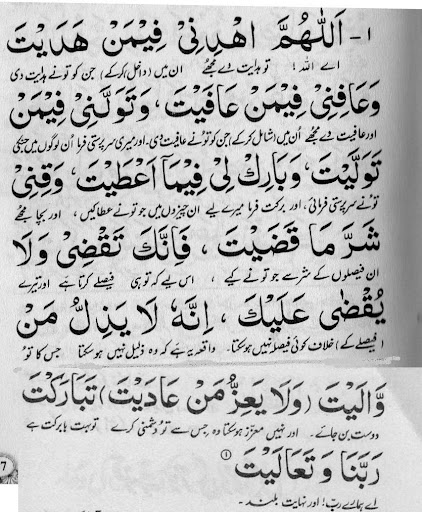
The version which the Messenger of Allaah (peace and blessings of Allaah be upon him) taught to al-Hasan ibn ‘Ali (may Allaah be pleased with him), which is: 
“Allaahumma ihdini feeman hadayta wa ‘aafini feeman ‘aafayta wa tawallani feeman tawallayta wa baarik li feema a’tayta, wa qini sharra ma qadayta , fa innaka taqdi wa la yuqda ‘alayk, wa innahu laa yadhillu man waalayta wa laa ya’izzu man ‘aadayta, tabaarakta Rabbana wa ta’aalayta la munji minka illa ilayk."
(O Allaah, guide me among those whom You have guided, pardon me among those whom You have pardoned, turn to me in friendship among those on whom You have turned in friendship, and bless me in what You have bestowed, and save me from the evil of what You have decreed. For verily You decree and none can influence You; and he is not humiliated whom You have befriended, nor is he honoured who is Your enemy. Blessed are You, O Lord, and Exalted. There is no place of safety from You except with You).”
(Narrated by Abu Dawood, 1213; al-Nasaa’i, 1725; classed as saheeh by al-Albaani in al-Irwa’, 429). 
It was narrated from ‘Ali ibn Abi Taalib that the Prophet (peace and blessings of Allaah be upon him) used to say at the end of Witr
“Allaahumma inni a’oodhu bi ridaaka min sakhatika wa bi mu’aafaatika min ‘uqoobatika wa a’oodhu bika minka, la uhsi thana’an ‘alayka anta kama athnayta ‘ala nafsika (O Allaah, I seek refuge in Your pleasure from Your wrath and in Your forgiveness from Your punishment. I cannot praise You enough; You are as You have praised Yourself.” 
(Narrated by al-Tirmidhi, 1727; classed as saheeh by al-Albaani in al-Irwa’, 430; Saheeh Abi Dawood, 1282). 
Then he should send blessings upon the Prophet (peace and blessings of Allaah be upon him) as it was narrated that some of the Sahaabah (may Allaah be pleased with them) – including Ubayy ibn Ka’b and Mu’aadh al-Ansaary (may Allaah be pleased with them) – did that at the end of Qunoot al-Witr. 
(See Tasheeh al-Du’aa’ by Shaykh Bakr Abu Zayd, p. 460).

Qunoot in Witr Every Night?

There is nothing wrong with that. The du’aa’ of Qunoot is Sunnah and the Prophet (blessings and peace of Allah be upon him) used to recite Qunoot. He taught Qunoot and the words of Qunoot in Witr to al-Hasan, so it is Sunnah. If you recite it every night, there is nothing wrong with that, and if you omit it on some occasions so that the people will know that it is not obligatory, there is nothing wrong with that either. If the imam omits Qunoot on some occasions so that the people will know that is not obligatory, there is nothing wrong with that. When the Prophet (blessings and peace of Allah be upon him) taught al-Hasan Qunoot, he did not tell him to omit it on some days. This indicates that if he does it persistently, there is nothing wrong with that.
Shaykh ‘Abd al-‘Azeez ibn Baaz (may Allah have mercy on him).
[IslamQA]

Qunoot at times of calamity (Qunoot al-Naazilah) 

When praying Qunoot at the time of calamity, one should make supplication as is appropriate to the situation, as it was narrated that the Prophet (peace and blessings of Allaah be upon him) cursed some Arab tribes who had betrayed his companions and killed them, and he prayed for the weak and oppressed believers in Makkah, that Allaah would save them.  It was narrated that ‘Umar prayed Qunoot with the following words:
“Allaahumma inna nasta’eenuka wa nu’minu bika, wa natawakkalu ‘alayka wa nuthni ‘alayka al-khayr, wa laa nakfuruka. Allaahumma iyyaaka na’budu wa laka nusalli wa nasjudu, wa ilayka nas’aa wa nahfid. Narju rahmataka wa nakhsha ‘adhaabaka, inna ‘adhaabaka al-jadd bil kuffaari mulhaq. Allaahumma ‘adhdhib il-kafarata ahl al-kitaab alladheena yasuddoona ‘an sabeelika."
(O Allaah, verily we seek Your help, we believe in You, we put our trust in You and we praise You and we are not ungrateful to You. O Allaah, You alone we worship and to You we pray and prostrate, for Your sake we strive. We hope for Your mercy and fear Your punishment, for Your punishment will certainly reach the disbelievers.  O Allaah, punish the infidels of the People of the Book who are preventing others from following Your way).” 
This version is a bit different than the one in text above. But it works.
(Narrated by al-Bayhaqi, 2/210; classed as saheeh by al-Albaani in al-Irwa’, 2/170. Al-Albaani said: This was reported from ‘Umar concerning Qunoot in Fajr, and it seems that this Qunoot is Qunoot al-Naazilah (Qunoot at times of calamity) as is indicated by his praying against the kuffaar).

Saying Ameen after Qunoot

It is prescribed to say Ameen during the du’aa’ al-qunoot.
It is not obligatory to say the Ameen out loud, rather it is mustahabb, just as the Ameen itself is not obligatory.
[IslamQA]

Making Qunoot Calamity-Appropriate

Shaykh Ibn ‘Uthaymeen said in al-Sharh al-Mumti’ (4/45): He should say Qunoot with a supplication that is appropriate to the calamity that has come. Hence the Messenger (blessings and peace of Allaah be upon him) used to say Qunoot with words that were appropriate to the calamity, and he did not say “Allaahumma ihdini fiman hadayta/O Allaah, guide me among those whom You have guided…” as some of the common folk do. It is not narrated in any hadeeth, saheeh or da’eef, that the Messenger (blessings and peace of Allaah be upon him) ever used to say “Allaahumma ihdini fiman hadayta/O Allaah, guide me among those whom You have guided…”) in obligatory prayers; rather he would offer a supplication that was appropriate to that calamity. On one occasion, he (blessings and peace of Allaah be upon him) prayed for some of the weak and oppressed people, asking Allaah to save them, until they came (to him in Madeenah). End quote.
Based on this, the worshipper should choose a supplication that is appropriate to the calamity, and say that.
Whoever says the du’aa’ of the Prophet (blessings and peace of Allaah be upon him) because it is appropriate to a calamity that has befallen the Muslim, such as saying with regard to that which has befallen us nowadays, “O Allaah, save the weak and oppressed believers in Gaza; O Allaah, help them; O Allaah, punish the Jews and Christians, and those who support and help them, severely; O Allaah, curse them; O Allaah, send upon them years like the years of Yoosuf,” has done well, because the supplication of the Prophet (blessings and peace of Allaah be upon him) is the best and most comprehensive supplication that can be offered.
And Allaah knows best.
[IslamQA]
A very detailed post on Qunoot here, and the answer to "for how long should the qunoot nazila be recited" here.
Ahhhh! I don't know about you, but I definitely learnt a LOT of new stuff today. Alhamdulillah. <3
Wassalam.

Witr - While Traveling (Ahadith 811 - 812)


Assalamu`alaykum,
Bismillah.

Volume 2, Book 16, Number 811:
Narrated Said bin Yasar:
I was going to Mecca in the company of 'Abdullah bin 'Umar and when I apprehended the approaching dawn, I dismounted and offered the Witr prayer and then joined him. 'Abdullah bin 'Umar said, "Where have you been?" I replied, "I apprehended the approaching dawn so I dismounted and prayed the Witr prayer." 'Abdullah said, "Isn't it sufficient for you to follow the good example of Allah's Apostle?" I replied, "Yes, by Allah." He said, "Allah's Apostle used to pray Witr on the back of the camel (while on a journey)."

Volume 2, Book 16, Number 812:
Narrated Ibn 'Umar:
The Prophet used to offer (Nawafil) prayers on his Rahila (mount) facing its direction by signals, but not the compulsory prayer. He also used to pray Witr on his (mount) Rahila.

1. Prophet (SAW) used to pray witr while traveling. Meaning, even while you're shortening the prayers in your travel, you still pray the witr prayer.
The majority of scholars (jumhoor ul-'ulmeaa') assert that salaat ul-witr (witr prayer) is a sunnah mu'akkada (confirmed sunnah that the Prophet peace be upon him, practiced consistently), and that it is not obligatory. This is based on the hadith (saying) regarding the bedouin who once came to the Prophet asking about Islam, the Prophet answered, "Five prayers within one day-and-night." The bedouin asked, "Am I obliged to other than those?" The Prophet replied, "Unless you volunteer of your own." (al-hadith muttafaqun alaih.)
Some scholars have said that qiyaam ul-layl (prayer at the heart of night) and salaat ul-witr are the best of the voluntary prayers (al-nawaafil). Therefore, one should consistently practice them and not neglect them. The Prophet did not neglect the prayers during night nor two rak'ah before al-fajr neither in residence nor in travel (as related in al-sunnah al-sahihah).
[IslamQA]
L.O.V.E this picture! <3
2. He (SAW) used to pray witr on the mount (camel). Meaning, you need not get off your car in order to pray witr.
Ibn 'Umar (may Allaah be pleased with him) said:
"The Prophet (peace and blessings of Allaah be upon him) used to pray voluntary (nafl) prayers when riding on his camel, no matter what direction it was facing, when he came from Makkah to Madeenah." Then Ibn 'Umar recited this aayah (interpretation of the meaning): "And to Allaah belong the east and the west, so wherever you turn yourselves or your faces, there is the Face of Allaah (and He is High above, over His Throne)…" [al-Baqarah 2:115]
Ibn 'Umar said: "It was concerning this that this aayah was revealed." (Reported by al-Tirmidhi, 2883; he said, this is a saheeh hasan hadeeth)
Further:
And it (facing qiblah direction) does not apply to one who is praying a naafil prayer or witr prayer whilst riding on a riding-animal etc., but it is.. mustahabb for him to face the qiblah if he is able to do so when pronouncing the takbeer of ihraam (at the beginning of the prayer), then he may face whatever direction he is facing.
*The awkward moment when you can't seem to make your keyboard type English from left to right* :/
Wassalam. 

Witr - Last Prayer of the Night (Hadith No. 810)


Assalamu`alaykum,
Bismillah.

Volume 2, Book 16, Number 810:
Narrated 'Abdullah bin 'Umar:
The Prophet (p.b.u.h) said, "Make witr as your last prayer at night."

Time for witr starts with `Ishaa' and ends with dawn. One may pray it in whatever part of the night he wishes. What's important is to make it the last prayer of the night. So for example, you plan to sleep right after `Ishaa' and wake up for Fajr directly, then you must pray witr before going to sleep. But if you intend to wake up for Tahajjud, then don't pray the witr prayer before sleeping. When you get up for the Night Prayer, pray your nawafil and then your witr. After that, pray Fajr when the time comes. So that witr remains your last prayer of the night.

Now the question is, if one prays after witr, is it like not allowed at all? Some say it's okay to do it, some say it's not.

But the correct view is that one may pray nawafil after witr, BUT one must not repeat witr. Here's a very comprehensive answer:
There is nothing wrong with the person who prays Witr in the first part of the night or the middle of the night offering any naafil prayers he wants after Witr, even though it is mustahabb for the last of his prayer at night to be Witr. In this case he should not repeat Witr, rather the Witr that he prayed at the beginning of the night is sufficient.
It was narrated that ‘Abd-Allaah ibn ‘Umar said: The Messenger of Allaah (peace and blessings of Allaah be upon him) said: “Make the last of your prayer at night Witr.” Narrated by al-Bukhaari, 998; Muslim, 749.
And it was narrated that that Talq ibn ‘Ali said: I heard the Messenger of Allaah (peace and blessings of Allaah be upon him) say, “There should not be two Witrs in one night.” Narrated by al-Tirmidhi, 470; al-Nasaa’i, 1679; Abu Dawood, 1439. Classed as saheeh by Shaykh al-Albaani in Saheeh al-Jaami’, 7567.
Ibn Hazm said in al-Muhalla, 2/92, 93:
Witr at the end of the night is better, but whoever prays Witr at the beginning of the night, that is fine. It is permissible to pray after Witr but one should not repeat Witr. 
Al-Nawawi said in al-Majmoo, 3/512:
If a person prays Witr then he wants to offer a naafil prayer etc at night, that is permissible and is not makrooh, but he should not repeat Witr. The evidence for that is the hadeeth of ‘Aa’ishah (may Allaah be pleased with her) who was asked about the Witr of the Messenger of Allaah (peace and blessings of Allaah be upon him). She said: “We used to prepare his siwaak (tooth stick) and water for wudoo’ for him, then Allaah would cause him to wake up at any time He willed at night. He would use the tooth stick, do wudoo’ and pray nine rak’ahs, in which he would not sit except in the eighth, when he would remember Allaah, glorify Him and make du’aa’.  Then he would get up without saying salaam, and pray the ninth rak’ah. Then he would sit down and again remember Allaah, glorify Him and make du’aa’. Then he would say a salaam that we could hear, then he would pray two rak’ahs after that, whilst sitting down.” Narrated by Muslim; this is part of a lengthy hadeeth, which is to be understood as meaning that the Prophet (peace and blessings of Allaah be upon him) prayed two rak’ahs after Witr to show that it is permissible to pray after Witr. 
And Allaah knows best.
[IslamQA]
Wassalam.

Y U NO? (Hadith No. 809)


Assalamu`alaykum,
Bismillah.

Here's the complete title of this post: Y U NO WAKE YOUR SPOUSE UP FOR TAHAJJUD/WITR?

Volume 2, Book 16, Number 809:
Narrated 'Aisha :
The Prophet (p.b.u.h) used to offer his night prayer while I was sleeping across in his bed. Whenever he intended to offer the Witr prayer, he used to wake me up and I would offer the Witr prayer too.
Nuff said. Hehe.
It is highly recommended that one wakes up one's own partner for this prayer. Abu Hurairah quoted the Prophet (peace and blessings be upon him) as saying:
“May Allah bless the man who gets up during the night to pray and wakes up his wife and who, if she refuses to get up, sprinkles water on her face. And may Allah bless the woman who gets up during the night to pray and wakes up her husband and who, if he refuses, sprinkles water on his face.” (Ahmad)
The Prophet (peace and blessings be upon him) also said:
“If a man wakes his wife and prays during the night or they pray two rak`ahs together, they will be recorded among those (men and women) who (constantly) make remembrance of Allah.” (Abu Dawud.)
May Allah give us the tawfeeq:
  • to have spouses who don't mind water being sprinkled on their faces while they're sleeping. :P
  • and to follow this beautiful Sunnah of the Prophet (SAW). <3
Y U NO? That was random..
Wassalam.

Disqus Shortname

designcart